Major Employers: Who Actually Employs People Here
Where people in Andalusia work today: a mix of healthcare, education, government, manufacturing, and retail. The days when one ...
Audio narration coming soon
A narrated version of Major Employers: Who Actually Employs People Here is being prepared.
When you ask where people in Andalusia work, the answer is a mix of healthcare, education, government, manufacturing, and retail. The days when one textile mill could employ 600 people are gone. What’s replaced them is a more diversified but also more modest employment base. Here’s who’s hiring.
Andalusia Health: The Big One
Andalusia Health, the city’s 88-bed hospital, is the largest employer in town and probably the most important institution in the local economy. The hospital opened in 1966 as Andalusia Regional Hospital and has gone through various ownership structures and expansions since. It now operates as part of Baptist Health, a regional healthcare system.
The hospital provides the full range of services you’d expect: emergency department, surgery, imaging, inpatient care, outpatient clinics, rehab services. People come here when they have a heart attack, deliver a baby, or need their gallbladder out. For serious trauma or specialized care, patients get transferred to Mobile or Montgomery, but for most medical needs, Andalusia Health is the anchor.
Employee count is likely in the range of 200 to 400 people: nurses, doctors, technicians, administrative staff, housekeeping, food service, and all the other roles that keep a hospital running. These are relatively stable jobs, many of them requiring specialized training, and they can’t be outsourced. You can move a shirt factory to Honduras. You can’t move an emergency room.
The hospital also generates secondary economic activity: medical offices, pharmacies, home health agencies, nursing homes, and other healthcare services cluster around it. For a city this size, having a functional hospital is economic survival along with healthcare access.
Andalusia Health was recognized as a Top 100 Rural & Community Hospital by the National Rural Health Association, which is a real achievement. Rural hospitals across the country are struggling financially, with dozens closing each year. Andalusia’s hospital is surviving and performing well enough to earn national recognition. That’s a big deal.
Shaw Industries: What’s Left of Manufacturing
Shaw Industries operates a carpet manufacturing plant in Andalusia, producing residential and commercial carpeting. Shaw is a Dalton, Georgia-based company that’s been in the carpet business for decades and is now owned by Warren Buffett’s Berkshire Hathaway.
The Andalusia plant represents the continuation of the city’s manufacturing history, though in much-reduced form compared to the textile heyday. Employment is estimated somewhere between 150 and 300, depending on market conditions and production levels. The plant has modernized over the years, with more automation and less manual labor than the old garment factories required.
Shaw jobs are solid middle-class work: better than retail, requiring some technical skill, offering benefits. They won’t make anyone rich, but they support a family if you’re careful with money.
The plant’s survival is a function of several things: Shaw’s size and efficiency, Berkshire Hathaway’s long-term investment approach, and the fact that carpet manufacturing has been somewhat more resistant to offshoring than apparel. Carpet is bulky to ship, installation matters, and there’s still a domestic market that values quick turnaround and customization. Still, the workforce is a fraction of what textile employment used to be across the county.
Andalusia City Schools: Education as Employer
The Andalusia City School System (covering elementary, middle, and high school) is both a major employer and a major reason people choose to live in the city. Teachers, administrators, counselors, cafeteria workers, custodians, bus drivers, coaches: all told, the school system likely employs 150 to 250 people.
Andalusia City Schools are highly regarded, consistently performing above state and national averages on standardized tests. That reputation matters. Families with kids often choose to live within the city limits specifically to access the city schools, which are separate from and generally considered stronger than the county system.
The schools also benefit from unusual financial support: the city dedicates a portion of its sales tax revenue (over $1 million per year) to supplement state education funding. That money pays for things like smaller class sizes, newer technology, better facilities, and competitive teacher salaries. It’s a significant municipal investment that doubles as economic development. Good schools attract and retain residents, which supports the tax base.
Lurleen B. Wallace Community College: The Workforce Pipeline
Lurleen B. Wallace Community College (LBWCC) operates a campus in Andalusia, offering associate degrees, technical certificates, and workforce training programs. Employment at the Andalusia campus is smaller than the main campus in Greenville, probably in the range of 50 to 100 people. The institution plays an outsized role in workforce development.
LBWCC partners with local employers to provide customized training, offers GED and adult education programs, and serves as a stepping stone for students who’ll transfer to four-year universities. For a city trying to build a skilled workforce without a major university nearby, the community college is essential infrastructure.
City of Andalusia: Municipal Government
The City of Andalusia itself is a significant employer, with departments including police, fire, public works, the electric department, water and gas utilities, parks and recreation, and city administration. Total employment is likely in the range of 100 to 200 people.
Municipal utilities are a particular strength. Andalusia operates its own electric, natural gas, and water systems, which gives the city more control over rates and service quality than cities dependent on private providers. The utilities also generate revenue that supports the general fund and helps keep property taxes relatively low.
The city’s been aggressive about infrastructure investment under Mayor Earl Johnson’s long tenure (since 2000). Projects include a new softball complex, an 18-acre fishing lake, a construction and demolition landfill with recycling facility, downtown revitalization efforts, and exploration of municipal broadband to compete with or replace Mediacom’s cable internet service.
City jobs are stable, come with benefits, and don’t disappear when the economy slumps. The pay is modest compared to private sector professional work, but the jobs stick around.
Covington County Government: The County Seat Advantage
As the county seat, Andalusia hosts Covington County government offices, the courthouse, the sheriff’s department, the probate court, the road department, and various other county agencies. Employment is probably in the range of 50 to 150 people.
County government jobs add to the local employment base and generate secondary economic activity. Lawyers, bail bondsmen, document services, and restaurants near the courthouse all benefit from the flow of people through the government complex.
Being the county seat also means Andalusia gets a steady stream of visitors who are required to come here for legal, administrative, or court purposes. That’s economic activity that smaller communities in the county don’t capture.
Retail and Service: The Long Tail
Beyond the major employers, Andalusia has the usual mix of retail and service businesses you’d find in any small city: Walmart, chain pharmacies, chain restaurants, gas stations, auto repair shops, local restaurants, boutiques, hair salons, law offices, medical clinics, insurance agencies, and so on.
Individually, these businesses employ anywhere from one or two people to a few dozen. Collectively, they probably employ several hundred people. The jobs are often part-time, lower-wage, and without benefits, but they’re also the jobs available to people without specialized training or education.
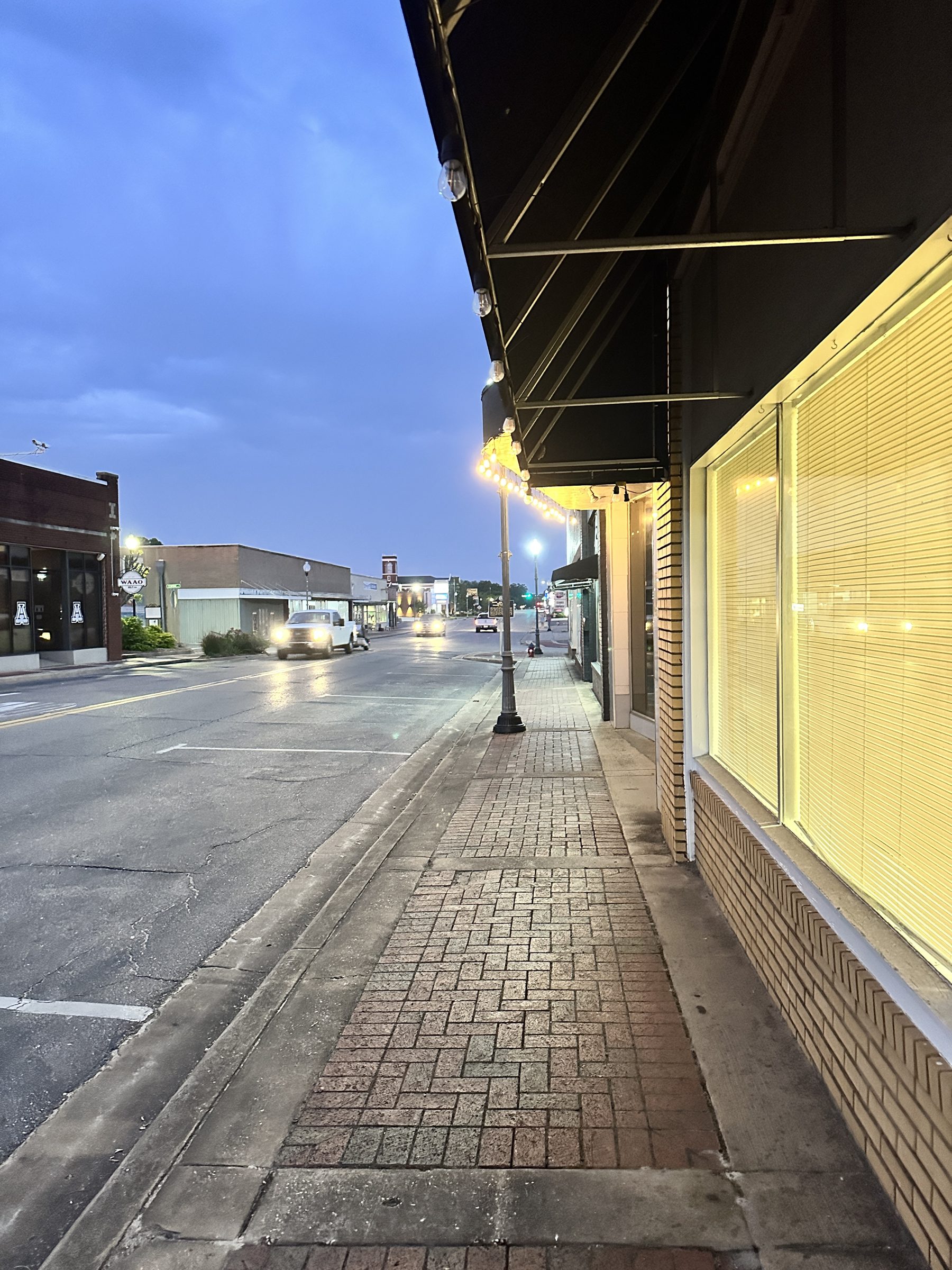
Downtown Andalusia has seen some revitalization in recent years, with new businesses opening and historic buildings being renovated. The First National Bank Building is being converted into The Andalusian, a boutique hotel. There’s an effort to create a walkable, attractive downtown that can draw both locals and visitors. Whether that translates into sustained economic growth or remains a modest improvement depends on factors largely outside the city’s control: regional population trends, highway traffic patterns, and whether people continue to shop in physical stores at all.
What’s Missing
Andalusia has no tech sector. No corporate headquarters. No major distribution center. No significant tourism industry beyond people passing through or visiting family. No university (just the community college campus). No military base. No major construction or engineering firm.
The absence of high-wage professional employment is one reason the median household income is $26,856, about half the state average. For young people with college degrees, jobs that match their qualifications are scarce here, so they leave.
That’s the reality for small Southern cities that weren’t on an interstate, didn’t land a big factory in the 1990s, and aren’t close enough to a metro area to function as a suburb. You work with what you have: healthcare, schools, government, a bit of manufacturing, retail, and services. That’s enough to sustain a community, though not enough to generate rapid growth or widespread prosperity.
The question facing Andalusia (like hundreds of similar cities) is whether it’s possible to build a 21st-century economy in a place that wasn’t naturally positioned for one, or whether the city’s role is simply to be a decent, stable place for people who value small-town life over maximum economic opportunity. Both are legitimate answers, but they lead to very different strategies.