Historic Landmarks and Downtown
Walk into downtown Andalusia on a Saturday morning and you're standing in a place that's been the center of Covington County life since 1844. Court Square anchors everything — the courthouse, the c...
Audio narration coming soon
A narrated version of Historic Landmarks and Downtown is being prepared.
Walk into downtown Andalusia on a Saturday morning and you’re standing in a place that’s been the center of Covington County life since 1844. Court Square anchors everything — the courthouse, the city offices, the events that mark the seasons. The buildings around the square tell the story in brick and stone: early 20th-century optimism, textile money, railroad prosperity, and a deliberate choice in the past two decades not to let it all fall apart.
This is a working downtown, not a preserved museum district. The county clerk’s office operates out of the 1916 courthouse, people eat lunch at Milepost 5 in the old bank building, the ballet school runs classes in what used to be an elementary school. Preservation here has meant finding new uses for old buildings rather than roping them off behind plaques.
Court Square and the Courthouse
The Covington County Courthouse sits at the center of Court Square, where it’s dominated sight lines since 1916. Frank Lockwood designed it — he designed courthouses all over Alabama during the courthouse construction boom of the early 1900s. This one’s built of granite and marble, solid enough to survive a century of Alabama summers and the occasional hurricane that pushes inland from the Gulf.
It’s the fourth courthouse to serve Covington County. The earlier ones, back when Montezuma was the county seat on the Conecuh River, burned. Courthouse arsons weren’t uncommon in the 19th-century South when land records and criminal proceedings made powerful people nervous. This one’s lasted because fire codes improved and because the county seat moved to higher ground after the 1841 flood that drowned Montezuma.
The courthouse functions today exactly as it did in 1916 — county government offices, courtrooms, property records. In December 2017, they held a centennial ceremony in the main courtroom. U.S. District Judge Harold Albritton spoke. His family practiced law in this building for four generations, from 1887 to 2014, the longest continuously operated law firm in Alabama history. That kind of continuity is what the building represents — the steady machinery of county government running through wars, depressions, integration, and the slow economic shifts that redefined what the South makes and grows.
Court Square itself serves as the event space for downtown. The Christmas tree goes up here during Candyland in December. The farmers market sets up on Saturday mornings. July Jamz concerts moved here from Springdale. The square is where Andalusia gathers when something needs gathering for.
The Andalusian Hotel
Look up from Court Square and you’ll see the tallest building in downtown — the old First National Bank Building, now called The Andalusian. Built in the 1930s when Andalusia’s textile mills were running strong and the town had money to make architectural statements. For decades, it was the financial center of the city, the place where farm loans and business deals got done.
When the bank closed, the building sat vacant. Out-of-state owners held the title but didn’t maintain it. The city spent eight years negotiating to buy it, finally closing the deal in 2017. They paid cash, bought it from owners in California and Texas who’d let it deteriorate.
The renovation came in phases. First, the ground floor became Milepost 5, a restaurant that also has locations in Enterprise, Troy, and Ozark. Then the upper floors converted to The Andalusian, a boutique hotel that opened in 2022. The project involved the city, the county commission, and private developers — property tax abatements and lodging tax rebates made the numbers work.
There’s a WSFA weather camera on the roof now, installed in 2017. It gives Montgomery television viewers a 360-degree view of Andalusia and puts the city on broadcast a few times a day. That kind of visibility matters for a town this size — free advertising every time the weatherman shows the radar.
The building’s vertical prominence and Art Deco lines make it the visual anchor of downtown. You can stay overnight now in what used to be the vault floor.
Springdale Estate
Springdale sits on four acres at 521 East Three Notch Street, built in the early 1930s by John G. Scherf. Scherf came to Andalusia from Germany to manage the Chamber of Commerce. He stayed, founded Alabama Textile Products Corporation (Ala-Tex), and served four terms as mayor. The estate he built reflected the prosperity that textile manufacturing brought to the city — six bedrooms, a four-car garage, guesthouse, meat cellar, fountains, a small lake, landscaped grounds.
When the property was scheduled for auction in 2010, the city bought it to keep it from being subdivided or developed. Springdale functions now as a public park and event venue. You can walk the grounds. You can rent it for weddings and receptions. July Jamz concerts were held here before moving downtown. During Candyland, the Christmas light displays include “ICE at Springdale.”
The estate represents a particular moment in Andalusia’s history — the textile era, when the mills employed hundreds and the owners built substantial homes. Those days are gone, but the building remains, repurposed for community use.
Three Notch Museum
The Three Notch Museum sits on historic Central Street, opened in 1987 by the Covington Historical Society. Admission is free, though contributions are accepted. The name comes from the old Three Notch Road — the Creek trade path and early territorial road that connected Georgia to the Gulf Coast. Three notches cut into trees marked the route.
Inside, you’ll find early photographs of Andalusia and Covington County, the kind that show dirt streets, mule wagons, storefronts before paved roads and automobiles. The Mark Gibson Miniature Railroad draws children — a detailed model railroad layout that captures local interest in trains. The River Falls Post Office was relocated here, along with the Clark Family Log Cabin, giving physical examples of 19th-century rural buildings.
The museum functions as local memory storage — the place where someone’s grandfather’s Civil War letters or grandmother’s wedding dress might end up. Open half days Monday, Tuesday, Wednesday, and by appointment. Small-town historical societies run on volunteer hours and whatever funding they can scrape together. This one’s been at it since the 1980s.
Veterans Memorial Park
Behind City Hall at 505 East Three Notch Street, the Veterans Memorial Park centers on a 42-foot stainless steel obelisk mounted on a black granite pedestal. Dedicated on Veterans Day 2004, the memorial was funded entirely through private contributions and brick sales — no tax dollars.
The pedestal lists the names of Covington County soldiers killed in military service, from World War I through the wars in Iraq and Afghanistan. Brick pavers surround the obelisk, each one purchased by families or community members to honor a veteran. The bricks form a five-pointed star layout representing the five branches of military service — Army, Navy, Air Force, Marines, Coast Guard.
The inscription reads: “To those who died, honor and eternal rest; to those who returned, gratitude and peace; to those in service remember and hope.”
Veterans Day and Memorial Day ceremonies happen here every year. In 2022, the city added a Veterans Memorial Wall as part of an expansion, unveiled during a July Jamz concert featuring Lee Greenwood, the patriotic music artist.
Military service runs deep in rural Alabama. Every small town has a memorial like this, listing names that belong to families still living in the county. The memorial is personal, not abstract.
Church Street Cultural Arts Centre
At 420 Church Street, the Cultural Arts Centre started life as a school built between 1921 and 1923. It served the city’s students until December 2000, when the school system moved to newer facilities. The building sat vacant for nearly a decade.
In 2010-2011, the city and the Andalusia Ballet Association partnered to renovate the old school into a dedicated arts space. The Ballet Association now operates its headquarters there, offering dance instruction. The building also houses music lessons and community theater rehearsals, making it the hub for Andalusia’s performing arts community.
The architecture reflects early 20th-century Southern school construction — masonry walls, high ceilings, large windows for natural light. Built to last and educate generations of children. Now it teaches a different curriculum, but the building still serves.
City Hall
City Hall at 505 East Three Notch Street was also built as a school, constructed in 1914. It operated as an educational facility for 87 years before the city bought it and completed a full restoration between 2002 and 2003, formally dedicating it as City Hall in January 2004.
The old auditorium was preserved and serves now for city meetings and public events. Walking into a government building that used to be a school gives the space a different character — you’re in rooms where generations of Andalusia children learned to read and do arithmetic.
Converting old schools to government or cultural use is a pattern in Andalusia. When school systems consolidate and move to new campuses, the old buildings have good bones — solid construction, central locations, large rooms. Better to repurpose them than let them sit empty or get demolished.
Clark Cinema
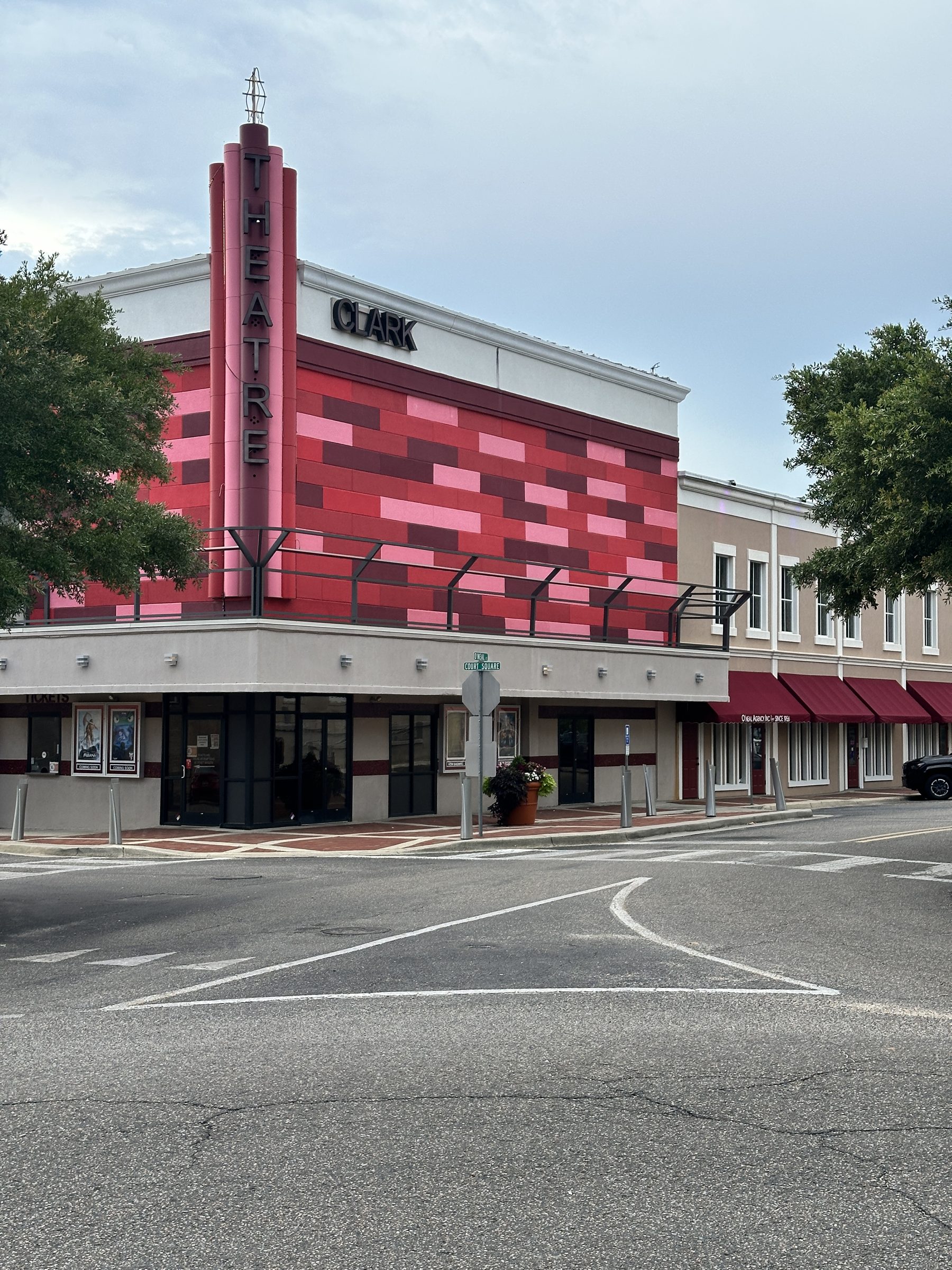
Clark Cinema operates as Andalusia’s movie theater, showing current releases in a small-town single-screen format. It’s not a landmark in the architectural sense, but it’s a functional piece of downtown life. Having a working theater downtown means people come into the square for movies, then walk to dinner or stop by other businesses.
Small-town theaters often don’t survive when multiplexes open in larger cities nearby. Clark Cinema has lasted because it serves a purpose — not everyone wants to drive 30 miles to Enterprise or Opp for a movie.
Downtown Murals
Wes Hardin, a Dothan artist, painted a series of historical murals on downtown buildings. The murals illustrate pieces of Andalusia’s and Covington County’s history:
- The Legend of Andalusia — the city’s founding story
- Early Covington County Courthouses — including the courthouse arsons
- Soda Fountain — evoking Riley’s Drug Store, which opened its soda fountain December 18, 1924
- Early Covington County Timber and Logging — showing the longleaf pine harvest and naval stores industry
Additional murals were approved for the Pirate Graphics building on East Three Notch Street. The murals are visible from the street, offering public art accessible to anyone walking or driving downtown. They serve an educational function, particularly for people too young to remember when timber mills and soda fountains defined the town’s economy and social life.
Heritage Park
Heritage Park preserves the outdoor heritage culture of the Wiregrass region. It’s not a traditional park with playgrounds — it’s designed around hunting, fishing, and outdoor traditions that define rural Alabama identity. The park connects to the broader story of how people in Covington County relate to the land and water.
Chamber of Commerce and the Big Shirt
The Andalusia Chamber of Commerce operates from 700 River Falls Street, housed in the former headquarters of Ala-Tex (Alabama Textile Products Corporation). The grounds feature Andalusia’s “Big Shirt” monument — a tribute to the city’s textile manufacturing era.
Mural panels on the grounds depict the dress shirt manufacturing process, from cutting fabric to final inspection. The panels honor the apparel industry leaders who built the textile economy that sustained Andalusia through much of the 20th century.
The textile mills are mostly gone now, shut down or moved offshore during the waves of deindustrialization that hit the American South. The Big Shirt and the murals are memorials to an economy that no longer exists but shaped everything about how modern Andalusia developed. The jobs, the paychecks, the prosperity that built Springdale and the bank building — all came from making shirts.
Walking Downtown
Court Square is the starting point. Stand at the courthouse and look around. The Andalusian rises to the southeast. City Hall sits to the east on Three Notch Street. The Chamber is farther down River Falls. Springdale is a short walk east on Three Notch. The Three Notch Museum and Church Street Cultural Arts Centre are nearby.
Most of downtown fits within a half-mile radius. You can walk it in an hour if you’re just covering ground, longer if you stop to read the murals or go inside the museum. Saturday mornings during farmers market season or evenings during July Jamz give you the best sense of how the square functions as a gathering space.
The buildings aren’t roped off or turned into house museums. They’re working spaces — government offices, restaurants, a hotel, a ballet school, a theater. Preservation here has meant keeping buildings in use, finding tenants, adapting the structures to new purposes. It’s a pragmatic approach, driven by a city government that decided buying and repurposing old buildings was better than watching them collapse.
This is what a small Southern downtown looks like when it doesn’t give up — not pristine, not wealthy, but functional and deliberately maintained. Court Square has been the center of Covington County since 1844. It still is.