Conecuh National Forest: A Field Guide to the Longleaf Restoration
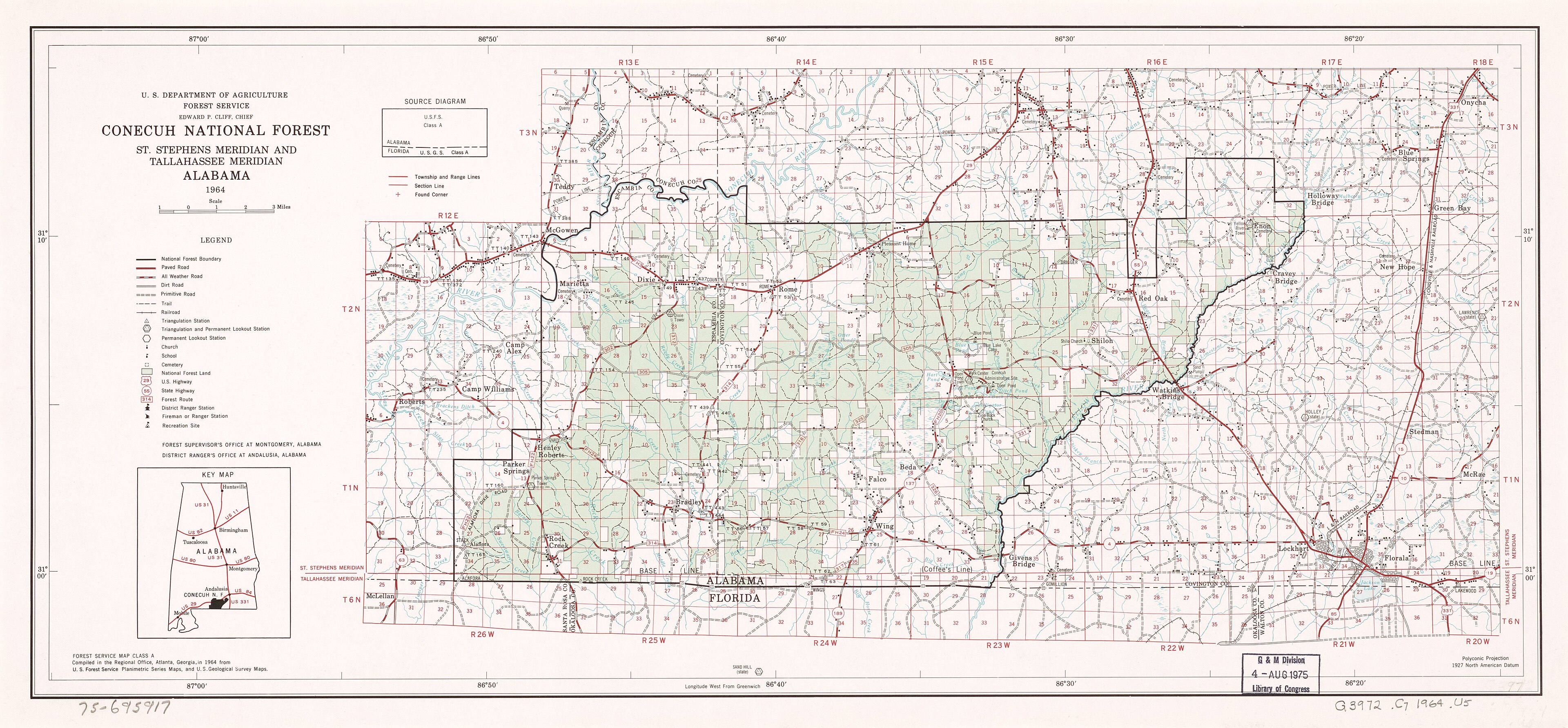
84,000 acres | Southern Covington County & Northern Escambia County, Alabama Managed by: USDA Forest Service, National Forests in Alabama Ranger District Headquarters: Andalusia, Alabama
Audio narration coming soon
A narrated version of Conecuh National Forest: A Field Guide to the Longleaf Restoration is being prepared.
84,000 acres | Southern Covington County & Northern Escambia County, Alabama Managed by: USDA Forest Service, National Forests in Alabama Ranger District Headquarters: Andalusia, Alabama
Conecuh National Forest is a recovering landscape, a place where one of the most destructive chapters in American environmental history is slowly being rewritten through fire, science, and patient management. Not a pristine wilderness. If you understand what you’re looking at, you’re seeing one of the most significant ecological stories in the Southeast.
What Happened Here: The Longleaf Collapse
Before European settlement, longleaf pine forests covered roughly 90 million acres across the Southeast, from Virginia to Texas. The Wiregrass region — named for the wiry, fire-adapted grass that grows beneath longleaf canopies — was part of that vast, fire-maintained ecosystem.
Then came the timber boom.
Between the 1880s and the 1930s, industrial logging companies clear-cut the longleaf forests at a pace and scale that’s hard to comprehend today. Naval stores operations (turpentine and resin extraction) weakened the trees before they were felled. Railroads pushed into previously inaccessible areas, opening up the last remnants of old-growth forest to saw blades and turpentine stills.
By the 1930s, the longleaf ecosystem had collapsed. What had once been 90 million acres was reduced to fewer than 3 million — a 97% loss. The land was exhausted, eroded, and largely abandoned by the timber companies that had extracted everything of value.
The federal government stepped in. In 1935, under the Weeks Act (which authorized federal purchase of cutover forest land for watershed protection and timber regeneration), the Conecuh National Forest was established. The land was cheap — nobody wanted it. The Forest Service’s job was to stabilize the soil, replant trees, and prevent further degradation.
What you see today is the result of 90 years of recovery.
The Longleaf Pine Ecosystem: Fire, Grass, and Biodiversity
Longleaf pine (Pinus palustris) is not like other Southern pines. It’s slow-growing, long-lived (up to 500 years), and deeply dependent on fire. Without frequent, low-intensity burns, longleaf forests transition into dense hardwood thickets, and the ecosystem collapses.
Here’s how it works:
Fire suppression kills longleaf habitat. For most of the 20th century, the Forest Service (and American land management in general) operated under a fire suppression doctrine: all fires were bad, and all fires should be stopped. This was catastrophic for fire-adapted ecosystems like longleaf pine forests.
Without fire, the understory fills with hardwoods (oaks, sweetgums, maples), which shade out the wiregrass and native groundcover. The forest becomes a closed-canopy jungle, and the species that depend on open, grassy understory — red-cockaded woodpeckers, gopher tortoises, indigo snakes, ground-nesting birds, rare wildflowers — disappear.
Prescribed fire is restoration. Beginning in the 1970s, ecologists and land managers began to understand that fire wasn’t the enemy — fire suppression was. The Forest Service, working with academic researchers and conservation organizations, reintroduced prescribed burning to Conecuh National Forest.
Today, the forest is burned on a rotating schedule, with different units burned every 2-3 years. The burns are carefully planned — conducted in winter and early spring when conditions are right, using trained crews with fire lines, drip torches, and weather monitoring. The goal is to mimic the natural fire regime that shaped this ecosystem for millennia: frequent, low-intensity burns that clear the understory, recycle nutrients, and favor fire-adapted species.
If you see smoke rising from the forest, that’s not an emergency — it’s management. And it’s working. The longleaf pine stands in Conecuh are healthier, more diverse, and more ecologically functional than they’ve been in a century.
Wildlife: What Lives Here and Why It Matters
Conecuh National Forest is one of the most important wildlife refuges in the Southeast, particularly for species that have nowhere else to go.
Red-Cockaded Woodpecker (Endangered)
The red-cockaded woodpecker (RCW) is the flagship species of longleaf pine restoration. It’s a small, black-and-white woodpecker with a tiny red streak on the male’s head (the “cockade”). Unlike most woodpeckers, which nest in dead trees, RCWs excavate cavities in living longleaf pines that are at least 60-80 years old and infected with red heart fungus (which softens the heartwood).
This makes them extraordinarily vulnerable. When the longleaf forests were logged, the RCW lost its nesting habitat. By the 1970s, the species was listed as endangered, with only a few thousand birds remaining.
Conecuh National Forest is now a core recovery site for the RCW. The Forest Service actively manages cavity trees, monitors nesting success, and uses artificial cavities (drilled starter holes) to increase available habitat. You’ll see trees marked with white bands — those are active RCW cavity trees. Federal law prohibits disturbing them, so give them space.
If you want to see an RCW, your best bet is dawn or dusk near known cavity tree clusters. They’re vocal, social birds, and often forage in family groups. The Forest Service can point you to accessible viewing areas.
Gopher Tortoise (Keystone Species)
The gopher tortoise (Gopherus polyphemus) is a keystone species — an animal whose presence structures the entire ecosystem. Gopher tortoises dig deep burrows (up to 40 feet long, 10 feet deep) in the sandy soil, creating refuges that are used by over 350 other species, including indigo snakes, burrowing owls, gopher frogs, and invertebrates.
Gopher tortoises are long-lived (60+ years), slow to reproduce, and vulnerable to habitat loss. Longleaf pine forests with open, grassy understories are their preferred habitat. As the forest recovers, so do gopher tortoise populations.
If you see a burrow with a sandy apron in front of it (often near the base of a tree or in an open area), that’s a gopher tortoise den. Don’t disturb it. And if you see a tortoise crossing a forest road, give it time. They’re not fast.
Eastern Indigo Snake (Threatened)
The eastern indigo snake is the longest native snake in North America (up to 8 feet) and one of the most striking — glossy, blue-black scales, no pattern, and a powerful, docile demeanor. They’re non-venomous constrictors that eat other snakes (including rattlesnakes), rodents, and small mammals.
Indigos rely on gopher tortoise burrows for shelter, particularly in winter. They’re listed as federally threatened due to habitat loss and historical overcollection for the pet trade. Conecuh National Forest is one of the few places in Alabama where they still occur.
If you see one, consider yourself lucky. They’re shy, rarely seen, and protected by federal law.
Pitcher Plants and Carnivorous Flora
Scattered through the forest are seepage bogs — wet, acidic, nutrient-poor areas where carnivorous plants thrive. You’ll find:
- White-topped pitcher plants (Sarracenia leucophylla) — tall, elegant pitchers with white hoods and red veins that trap and digest insects.
- Parrot pitcher plants (Sarracenia psittacina) — low, reddish pitchers that lie nearly flat on the ground.
- Sundews (Drosera spp.) — tiny, sticky-leaved plants that capture insects on glandular hairs.
- Butterworts (Pinguicula spp.) — delicate purple flowers above sticky, insect-trapping leaves.
These bogs are fire-dependent. Without regular burns, woody vegetation shades them out and they disappear. The Forest Service carefully manages these sites, and some are closed to public access to prevent trampling.
If you find one, take photos but don’t touch. These plants are slow-growing, and human disturbance can kill them.
Recreation: Trails, Camping, and Water
Conecuh Trail (20 miles)
The Conecuh Trail is a 20-mile loop that cuts through the heart of the forest, crossing creeks, moving through longleaf stands, and passing through varied habitats. It’s not a heavily trafficked trail — you can hike for hours without seeing another person.
What to expect:
- Terrain: Flat to gently rolling. The forest sits on the Gulf Coastal Plain, so there are no mountains, but you will gain and lose elevation crossing creek valleys.
- Surface: Sandy soil, pine needles, occasional mud (especially after rain). Roots and blowdowns are common.
- Water crossings: Several creeks, mostly bridged, but water levels vary. After heavy rain, some crossings can be knee-deep.
- Blazes: White blazes mark the trail. They’re generally well-maintained, but pay attention — it’s easy to lose the trail if you’re not watching.
- Camping: Primitive camping is allowed along the trail. No facilities — pack in, pack out.
Best seasons: Fall and winter (October-March). Summer is brutally hot and humid, with aggressive biting insects. Spring (April-May) is beautiful for wildflowers, but the mosquitoes are vicious.
Trailhead: Blue Lake Recreation Area (on AL Highway 137, south of Andalusia).
Open Pond Recreation Area
Location: Near Wing, Alabama (south of Andalusia on US 29, then west on CR 24)
Open Pond is the most developed recreation site in the forest, built by the Civilian Conservation Corps (CCC) in the 1930s. Some of the original CCC structures — stone and timber buildings — are still standing.
Facilities:
- Camping: 42 sites with picnic tables and fire rings. Some have electrical hookups; most are primitive. Restrooms and showers available.
- Lake: Spring-fed, tannic-stained water with a sandy bottom. Small swimming beach, bathhouse (CCC-era stone building).
- Trails: Several short interpretive trails loop through the surrounding forest.
- Accessibility: Paved roads, vehicle access, suitable for RVs and trailers.
Why it’s special: Open Pond feels genuinely remote — surrounded by longleaf pines, quiet, no light pollution. The water is clear (despite the tea color), and the setting is about as close as you’ll get to what this landscape looked like before industrial logging.
Fee: Small day-use fee; camping fees vary by site type. Check the Forest Service website for current rates.
Blue Lake Recreation Area
Location: On AL Highway 137, south of Andalusia
Blue Lake is similar to Open Pond but smaller and less developed. It has a campground, a small lake, and trail access to the Conecuh Trail. It’s popular with hunters during the fall and winter, and quiet the rest of the year.
Fishing
Fishing in the national forest is mostly focused on farm ponds and small lakes scattered through the forest. Bass, bream, and catfish are the primary targets. The fishing is pleasant and uncrowded rather than spectacular. This isn’t a destination fishery.
You’ll need an Alabama freshwater fishing license (available online or at local sporting goods stores). Follow state regulations on size and bag limits.
Hunting
Conecuh National Forest is heavily used by hunters, particularly during deer and turkey seasons. The Alabama Department of Conservation and Natural Resources (ADCNR) manages hunting regulations, seasons, and bag limits.
Species:
- White-tailed deer (rifle and archery seasons, October-January)
- Wild turkey (spring and fall seasons)
- Feral hogs (year-round, no bag limit)
- Small game (squirrel, rabbit, dove)
What this means for non-hunters: During deer rifle season (roughly mid-November through January), the forest is busy with hunters. If you’re hiking or camping during this time, wear blaze orange (even though you’re not required to by law). It’s a basic safety measure.
Sundays are typically no-hunting days in Alabama, so if you want the forest to yourself, Sunday is your best bet during hunting season.
Birdwatching
Beyond the red-cockaded woodpecker, Conecuh is a productive birding location. Species include:
- Bachman’s sparrow (rare, fire-dependent grassland specialist)
- Brown-headed nuthatch (pine-dependent, vocal, easy to find)
- Northern bobwhite quail (declining but still present in managed areas)
- Wood thrushes (spring migrants, beautiful song)
- Wild turkeys (large flocks, often seen near roadsides)
- Pileated woodpeckers (large, dramatic, unmistakable)
- Red-headed woodpeckers (declining nationally, still common in burned areas)
Birding is best in early morning, especially in spring and fall during migration.
History: CCC Camps, German POWs, and Forest Rebirth
The history of Conecuh National Forest is inseparable from the Civilian Conservation Corps (CCC), one of the most successful programs of the New Deal.
CCC Camp Covington was established in the forest in the 1930s, housing young men (mostly from urban areas, many unemployed) who were put to work building roads, fire towers, trails, campgrounds, and erosion control structures. The CCC planted millions of trees (mostly slash pine and loblolly pine at first, later longleaf), built Open Pond and Blue Lake recreation areas, and laid the foundation for the forest infrastructure that exists today.
The work was hard, the pay was minimal ($30 a month, with $25 sent home to families), and the conditions were basic. But the CCC gave a generation of young men work, purpose, and job skills during the Depression, and it transformed millions of acres of degraded land into functioning forests.
During World War II, the forest also hosted German prisoners of war who were used as labor for forest management and timber operations. POW camps were common across the rural South during the war, and Conecuh was one of many sites where captured German soldiers worked in forestry, agriculture, and infrastructure projects.
The CCC program ended in 1942 (shifted toward war mobilization), but its legacy is everywhere in the forest. If you’re camping at Open Pond or hiking past a stone culvert or an old fire tower foundation, you’re using infrastructure built by CCC crews 90 years ago.
Practical Information
Access: The forest is accessible from US Highway 29 (south of Andalusia), AL Highway 137, and various county roads. Open Pond is the easiest entry point for first-time visitors.
Fees: Day use is generally free. Camping fees apply at developed campgrounds. Hunting requires Alabama licenses and permits.
Cell service: Spotty to nonexistent once you’re in the forest. Download maps before you go.
Water: Bring your own. There’s no potable water on the trails or at primitive campsites.
Hazards:
- Snakes: Venomous species include timber rattlesnakes, cottonmouths, and copperheads. They’re not aggressive, but watch where you step and sit.
- Ticks and chiggers: Aggressive, especially in summer. Use permethrin-treated clothing and check yourself after hikes.
- Heat and humidity: Summer temperatures regularly exceed 95°F with high humidity. Start early, carry water, know the signs of heat exhaustion.
- Storms: Thunderstorms are common in summer, and the forest is exposed. Lightning is a real hazard. Don’t stand under isolated tall trees.
Visitor information: Conecuh Ranger District office is in Andalusia at 24091 AL-55. Call ahead for trail conditions, burn schedules, and hunting season dates: (334) 222-2555.
Maps: The Forest Service provides free maps at the ranger station. For serious navigation, use USGS topographic maps or GPS apps like Gaia GPS or AllTrails (offline maps recommended).
Why It Matters
Conecuh National Forest is not a museum or a theme park. It’s a working forest — managed for wildlife, timber production, recreation, and watershed protection. But it’s also a laboratory for one of the most ambitious ecosystem restoration projects in the country.
The longleaf pine ecosystem was nearly destroyed in the span of 50 years. What’s happening at Conecuh — and at other longleaf restoration sites across the Southeast — is an attempt to reverse that loss, not through preservation alone, but through active management informed by ecology, fire science, and traditional knowledge.
It’s slow work. Longleaf pines take decades to mature. Fire regimes take years to stabilize. Wildlife populations recover gradually. But the trajectory is clear: this forest is getting healthier, more diverse, and more resilient.
If you’re interested in seeing what ecological restoration looks like at scale, Conecuh National Forest is worth your time. Just don’t expect it to be easy. The forest doesn’t cater to you — it operates on its own terms, shaped by fire, time, and the patient work of people who understand that some things can’t be rushed.