Explore Andalusia: Nature, History & the Longleaf Pine Frontier
The Andalusia area sits at a geographic sweet spot most people drive past without noticing: 85 miles north of the Gulf beaches, right on the edge of one of the most important ecological restoration...
Audio narration coming soon
A narrated version of Explore Andalusia: Nature, History & the Longleaf Pine Frontier is being prepared.
The Andalusia area sits at a geographic sweet spot most people drive past without noticing: 85 miles north of the Gulf beaches, right on the edge of one of the most important ecological restoration projects in the American South, and surrounded by waterways that have shaped human life here for thousands of years.
If you’re the kind of person who finds intact ecosystems more interesting than theme parks, or who’d rather fish a quiet cypress-lined lake than fight crowds at the beach, this corner of the Wiregrass has something to offer. It’s not wilderness — this land has been logged, farmed, burned, replanted, and managed for a century — but what’s happening here in terms of longleaf pine restoration and wildlife recovery is genuinely significant.
Conecuh National Forest: 84,000 Acres of Ecological Comeback
The star attraction is Conecuh National Forest, which sprawls across 84,000 acres of southern Covington County and northern Escambia County. This is a restored forest, not virgin land. The longleaf pine ecosystem that once covered 90 million acres across the Southeast was nearly destroyed by industrial logging between the 1880s and 1930s. What you see today is the result of decades of intentional restoration work by the U.S. Forest Service, using prescribed fire, selective harvesting, and wildlife management to bring back something that resembles what was here before.
The forest is managed from the Conecuh Ranger District office right here in Andalusia. If you’re serious about understanding what you’re looking at out there, stop by and talk to them. They know the burn schedules, the wildlife surveys, the trail conditions, and which parts of the forest are best for what you’re after.
What to do: The Conecuh Trail runs 20 miles through the heart of the forest, crossing creeks and moving through stands of longleaf pine in various stages of recovery. Expect a raw trail: roots, mud after rain, and the occasional blowdown, not a manicured greenway. Open Pond Recreation Area (near the community of Wing) offers developed camping, a swimming lake, and shorter trails. Blue Lake Recreation Area is another camping option. Both were built by the Civilian Conservation Corps in the 1930s, and some of those structures are still standing.
Wildlife: This is one of the most important habitats in the country for the red-cockaded woodpecker, an endangered species that nests only in old-growth longleaf pines. You’ll see trees marked with white bands — those are active cavity trees, and you’re not supposed to disturb them. The forest also supports gopher tortoises (a keystone species whose burrows shelter dozens of other animals), eastern indigo snakes, and rare pitcher plant bogs where carnivorous plants thrive in the nutrient-poor soil.
Fire ecology: If you see smoke, don’t panic. The Forest Service conducts prescribed burns throughout the year — it’s essential to maintaining longleaf pine habitat. The ecosystem evolved with frequent, low-intensity fires set by lightning and indigenous peoples. Without fire, hardwoods invade and the understory disappears. The burns you see today are continuation of a 10,000-year-old relationship between this landscape and flame.
Hunting: Conecuh is heavily used by hunters — deer, turkey, and small game. During hunting season (roughly October through January, with variations by species), you’ll want to wear blaze orange if you’re hiking. The Alabama Department of Conservation and Natural Resources manages the hunting regulations; check their website for current rules.
Getting there: The forest is accessible from US Highway 29 south of Andalusia. Open Pond is about 15 miles south of town. Entry is free. Cell service is spotty to nonexistent once you’re in the forest.
Lakes: Point A, Gantt, and Open Pond
If you’re looking for water recreation without driving to the coast, the Andalusia area has three distinct lake options.
Point A Lake (700 acres) is the main public recreation spot — a reservoir created in the 1960s with a swimming beach, boat ramp, fishing piers, and picnic areas. It’s a family destination, popular for bass fishing, and gets crowded on summer weekends. The lake is managed by the city and has a small marina with boat rentals.
Gantt Lake is quieter and more focused on fishing. It’s surrounded by cypress trees and has a reputation among local anglers as a solid bass and bream spot. Less developed than Point A, fewer amenities, more room to spread out.
Open Pond (in the national forest) is a natural spring-fed lake with a sandy bottom, surrounded by longleaf pines. The water is tannic — tea-colored from the organic material — but clear. It’s the most scenic of the three and feels genuinely remote. There’s a small beach and a bathhouse built by the CCC. Camping is right there, so you can roll out of your tent and be in the water in two minutes.
The Conecuh River
The Conecuh River is the watershed that defines this region. The name is Muscogee (Creek) — possibly meaning “land of cane,” referring to the giant rivercane that once grew in dense thickets along Southern waterways. The river was a major transportation route for indigenous peoples and later for Creek and European traders moving deerskins and other goods.
Today it’s a quiet, winding blackwater river bordered by floodplain forests. It’s popular for kayaking and canoeing, though you need to plan for access points and shuttle logistics. The current is gentle, the water is dark (tannic acid from decaying vegetation), and you’re likely to see turtles, wading birds, and alligators if you’re paying attention.
The Conecuh eventually flows into Florida, where it becomes the Escambia River and empties into Pensacola Bay. Ecologically, it connects the interior pine uplands to the coastal estuaries — a wildlife corridor that matters for migratory birds, anadromous fish, and everything in between.
Downtown Andalusia: History in Brick and Murals
If you want a break from the woods, downtown Andalusia has enough to fill an afternoon.
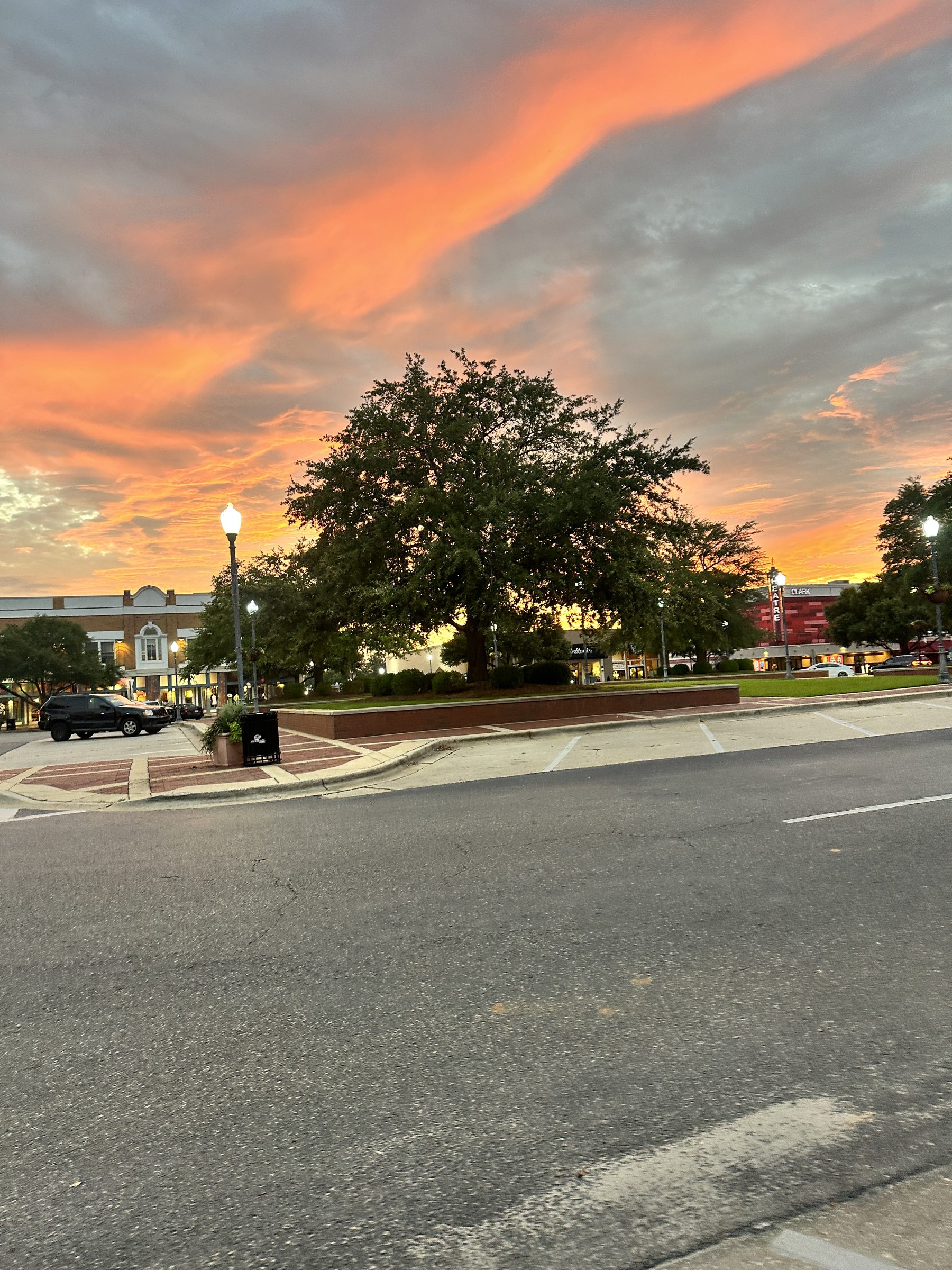
Court Square is the geographic center of town, anchored by the Covington County Courthouse (1916), designed by architect Frank Lockwood. The courthouse is still in active use, and it’s the fourth attempt at a permanent seat of government for Covington County — the previous three courthouses (in the now-vanished town of Montezuma) all burned down under suspicious circumstances in the 19th century.
Murals: Local artist Wes Hardin has painted a series of large-scale historical murals on downtown buildings. They depict scenes from Andalusia’s past — the timber industry, the railroad, early street life. It’s public history that doesn’t require a museum ticket.
The Andalusian hotel is a historic downtown building that’s been renovated in recent years as part of the city’s adaptive reuse strategy. Mayor Johnson and the city council have actively invested in buying and stabilizing historic structures rather than letting them deteriorate. It’s a deliberate preservation effort that’s kept the downtown’s character intact.
Three Notch Museum preserves local history and artifacts. The “Three Notch” name refers to the Federal Road, a military and trade route blazed in the early 1800s that connected Georgia to the new settlements in the Mississippi Territory. Trees along the route were marked with three axe notches to guide travelers. It passed right through what’s now Andalusia.
Springdale Estate: Textile Money, 1930s Style
Springdale is a 1930s mansion on about four acres just outside downtown. It was built by John G. Scherf, one of the textile barons who turned Andalusia into a mill town in the early 20th century. The house reflects the wealth generated by Riverside Mills and Springdale Mills — ornate, well-crafted, designed to impress.
For decades it was private property. Now it’s owned by the city and open for public events — weddings, receptions, tours. It’s a tangible reminder of the economic structure that shaped this place: a mill town with a clear hierarchy between ownership and labor, and architecture that reflected that divide.
Veterans Memorial Park
Behind City Hall is the Covington County Veterans Memorial Park, centered on a 42-foot stainless steel obelisk on a black granite pedestal. The names of Covington County residents who died in military service — from World War I through the Global War on Terror — are engraved on the base. Surrounding the obelisk are brick pavers purchased by families to honor veterans, living and dead.
It’s a solemn space, well-maintained, and clearly important to the community. Andalusia has a strong military tradition, and the memorial gets used for Veterans Day and Memorial Day ceremonies every year.
South Alabama Regional Airport
If you’re flying in, South Alabama Regional Airport (79J) has a 5,000-foot runway and can handle general aviation and small charter aircraft. It’s a public airport owned by the city, about 4 miles from downtown. Scheduled service is thin, though for self-flying pilots and charter passengers, it’s a convenient entry point.
Hunting Culture
Hunting is not a hobby here — it’s woven into the economy and the calendar. Deer season is a civic event. Turkey hunting has its own rituals and obsessives. Quail hunting, which was once the dominant form of hunting in the Wiregrass, has declined with habitat loss but still has dedicated practitioners.
The national forest gets heavy use during hunting season, but there’s also a lot of hunting on private land. Lease hunting (paying a landowner for seasonal access) is common. If you’re not from here and want to hunt, expect to either pay for a guide service or know someone who knows someone.
Pitcher Plant Bogs and Rare Habitats
Scattered through the Conecuh National Forest are pitcher plant bogs — wetland seeps where carnivorous plants have evolved to survive in nutrient-poor, acidic soils. You’ll find white-topped pitcher plants, sundews, and butterworts — all of which supplement their diet by trapping and digesting insects.
These bogs are fragile and rare. They depend on fire to keep woody plants from shading them out. The Forest Service manages them carefully, and some are off-limits to public access to prevent trampling. If you find one, look but don’t touch.
What This Place Is and Isn’t
Andalusia is not a resort town. It doesn’t have boutique hotels or farm-to-table restaurants. What it has is proximity to a genuinely significant ecological landscape, access to quiet water, a downtown that’s held onto its bones, and a community that takes both its history and its natural resources seriously.
If you’re looking for an introduction to longleaf pine ecology, a base camp for exploring Conecuh National Forest, or a break from the tourist-industrial complex of the Gulf Coast, this is worth a stop. Just set your expectations accordingly: this is a working town in a working forest, and the appeal is in what’s real, not what’s polished.