Community Life in Andalusia
Life in Andalusia, Alabama moves to rhythms that haven't changed much in generations. Sunday morning means church. Friday night in the fall means football. Tuesday evenings twice a month mean City ...
Audio narration coming soon
A narrated version of Community Life in Andalusia is being prepared.
Life in Andalusia, Alabama moves to rhythms that haven’t changed much in generations. Sunday morning means church. Friday night in the fall means football. Tuesday evenings twice a month mean City Council meetings at 6:00 PM sharp. Christmas means Candyland. And increasingly, it means Brenda Gantt cooking biscuits on Facebook Live, viewed by millions of people who’ve never set foot in Covington County but feel like they know this place through her kitchen window.
This is a city of 8,805 people where everyone knows everyone, or at least knows someone who knows everyone. Your church affiliation, your high school graduating class, and whether you’re “from here” define your social position as much as your job or your income. The median household income is $26,856, well below state and national averages, and the poverty rate hovers around 20 percent. Community wealth here gets counted in more than bank accounts. It’s measured in church potlucks, youth league coaching, volunteer fire departments, and the web of relationships that defines small-town Southern life.
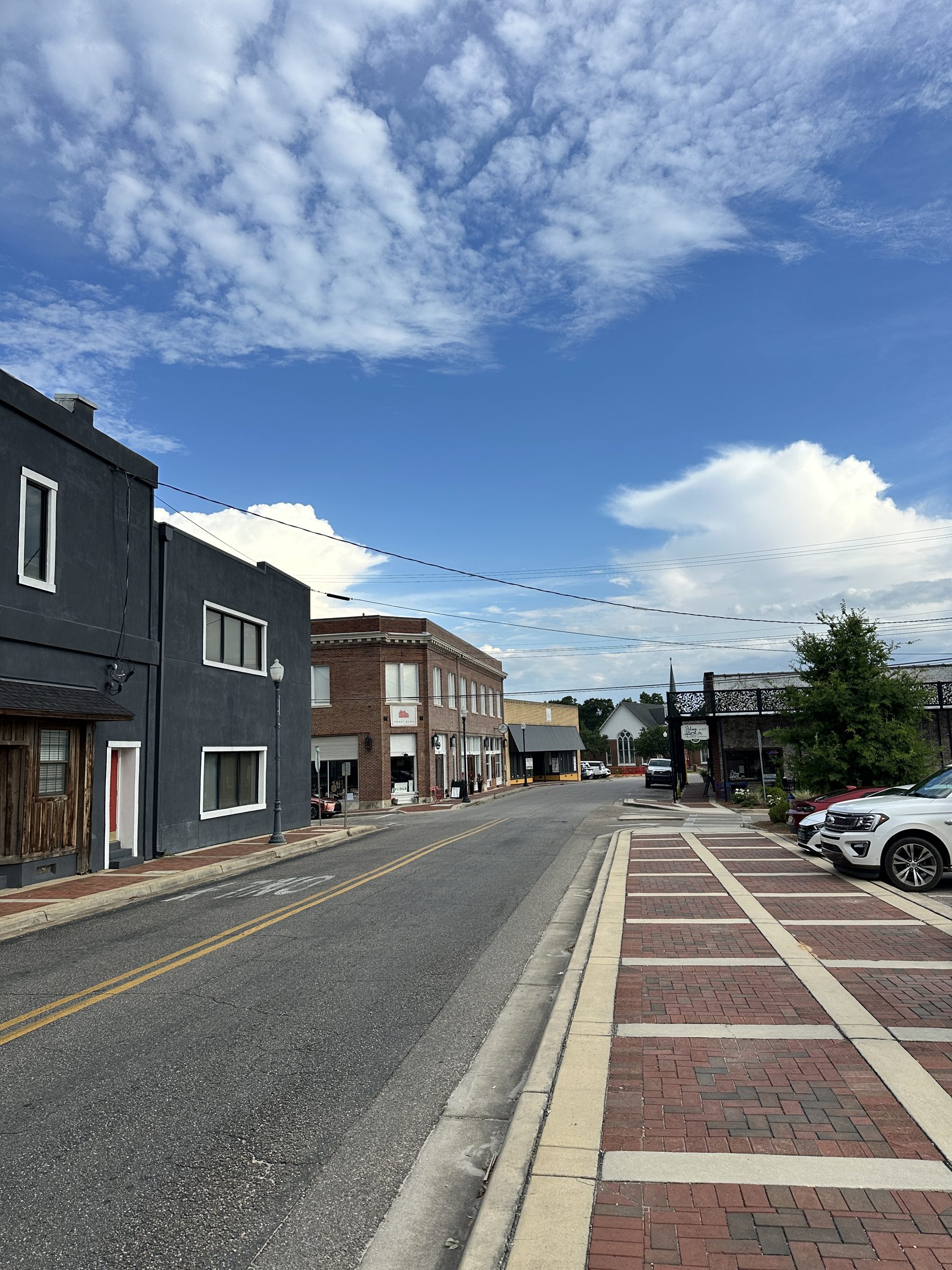
Andalusia is proud, genuinely so, and clear-eyed about its challenges. People here know what the city is up against. The population has declined slightly since 2010. Young people leave for college and often don’t come back. Downtown has empty storefronts alongside the revitalized ones. Entertainment options are limited enough that families regularly drive to Dothan or even Pensacola for shopping and dining. Alongside all that, there’s a stubborn determination to make this place work, to preserve what’s good about small-town life while building something better.
Churches: The Organizing Principle
In Andalusia, church is the foundation of your social network, your support system, and often your identity. Ask someone where they’re from in Andalusia and you’re likely to get a church affiliation along with a street name.
Sunday morning is still sacred here in a literal sense. Youth sports leagues won’t schedule games then. Most locally owned businesses stay closed. The rhythm of the week builds toward Sunday worship, midweek Bible study on Wednesday night, and the countless church activities in between: youth groups, mission trips, vacation Bible schools, men’s breakfasts, women’s circles, choir practice.
The major white Protestant congregations anchor the community. First Baptist Church, First Methodist, First Presbyterian, Central Baptist. These are large churches with expansive programs: daycare, Christian schools, extensive youth ministries. St. Mary’s Episcopal Church brings a different tradition, Anglo-Catholic liturgy in a building that feels transported from another era. Drive through town and you’ll count dozens more: Pentecostal churches, Churches of Christ, Assemblies of God, nondenominational community churches.
The Black community has its own parallel church structure, rooted in institutions that predate integration. First Baptist Church (Whatley Street) is the historic center of African-American church life, founded in 1883 with roots in a slave meeting house. Mount Zion Missionary Baptist, Bethel Missionary Baptist, and other historically Black congregations remain vibrant community centers where the legacy of the civil rights movement is remembered and honored.
These churches do far more than hold worship services. They run food pantries and clothes closets. They organize disaster relief when tornadoes strike. They provide space for AA meetings and community events. They’re where weddings, funerals, and the major life passages happen. For many residents, the church directory is more important than the city directory.
The centrality of church life creates invisible boundaries too. If you’re not plugged into a church network, you’re on the outside of much of Andalusia’s social life. Denominational lines can still matter, perhaps less than they once did, but they matter.
The Festival Year
Andalusia’s calendar is marked by annual events that bring the community together and, increasingly, draw visitors from across the region.
Christmas in Candyland is the crown jewel, a month-long celebration that transforms downtown into a holiday spectacle. Giant candy cane decorations line the streets. Thousands of lights twinkle from buildings and trees. The Kiwanis Candy Drop brings costumed characters and candy giveaways. There’s a parade, holiday shopping, special events at local businesses. The festival has become a major regional draw, with families from Dothan, Enterprise, even Pensacola making the drive to see Candyland. For one month a year, Andalusia’s downtown feels truly alive in a way it hasn’t year-round since the decline of downtown retail.
Mardi Gras might surprise people who don’t know South Alabama’s Gulf Coast cultural influence. Yes, there’s a Mardi Gras parade in Andalusia (smaller than Mobile’s, obviously, but real). Floats, beads, king cake, the whole tradition carried this far inland by families with connections to the coast.
Fourth of July brings fireworks and patriotic celebration, the kind of small-town Independence Day that Norman Rockwell would recognize. Homecoming season in the fall brings the football game alongside reunions, alumni gatherings, the whole ritual of returning to your roots.
The city has also begun using the Springdale Estate (a 1930s property with mansion and grounds that the city acquired) for public events. It’s a gorgeous venue, and there’s hope it can become an anchor for tourism and special events: weddings, festivals, cultural programming.
The Brenda Gantt Phenomenon
No discussion of contemporary Andalusia can ignore Brenda Gantt. She’s a grandmother who started cooking on Facebook Live during COVID, teaching people how to make biscuits and Southern food the old-fashioned way. Her audience grew to millions. Literally millions. Her videos get views that would be impressive for a major media company, much less a woman filming in her home kitchen in Andalusia, Alabama.
She’s put Andalusia on the map in a way nothing else has in decades. People from across the country now know this tiny South Alabama city because Brenda Gantt lives here. She’s published cookbooks that became bestsellers. She’s been profiled in major media. And she’s done it all while staying firmly rooted in Andalusia, cooking the food her mother and grandmother taught her to make.
The Brenda Gantt phenomenon is about more than recipes. It’s a hunger, literal and metaphorical, for the kind of authentic, unironic Southern culture she represents. Biscuits from scratch, cooking as an act of love, storytelling while you stir the pot, the kind of grandmother-in-the-kitchen experience that millions of people wish they had.
Her success has also sparked thinking about what Andalusia could be. If one woman filming in her kitchen can reach millions, what could the city do with intentional cultural programming, food tourism, heritage preservation? Early days, but Andalusia clearly has cultural assets worth celebrating and potentially monetizing.
Beyond Brenda Gantt, food culture here is what you’d expect in the Deep South: church potlucks with enough casseroles to feed an army, barbecue as serious business, Sunday lunch after church as an institution. Big Mike’s Steakhouse downtown has become an anchor of the downtown revitalization effort, a locally owned fine-dining restaurant that’s good enough to draw people from surrounding counties. Local restaurants, diners, and meat-and-threes keep the traditional foodways alive.
Friday Night Lights
If churches define the spiritual life of Andalusia, high school football defines its tribal identity. The Andalusia Bulldogs are a focus of community pride, conversation, and identity that outsiders might find baffling if they’ve never lived in a Southern town where football is what everyone talks about from August to December.
Friday nights in the fall, the stadium fills with thousands of people. Not only parents of players. Everyone. Grandparents, alumni who graduated forty years ago, elementary school kids who dream of wearing the Bulldog uniform someday, people with no children in school who just come because that’s what you do on Friday night.
The Bulldogs have a storied history with multiple state championships. The program has sent players to college ball and occasionally beyond. Coaching positions are prestigious, scrutinized, discussed endlessly at coffee shops and church fellowship halls. A good season brings euphoria. A losing season brings calls for change and endless Monday-morning quarterbacking.
This is mostly about community cohesion, about shared experience, about having something that brings the whole town together in a way that almost nothing else can anymore. The national anthem before kickoff, the band playing in the stands, the cheerleaders, the rivalry games against neighboring schools: these are the rituals that define community identity.
Youth football starts young, feeding the pipeline to the high school team. Parents spend countless hours at practices, games, team events. The investment of time and emotion in youth sports is enormous, sometimes productively so, sometimes to the point of dysfunction.
Beyond football, there’s basketball, baseball, softball, track. The Andalusia City Schools athletic program is competitive across the board, though football is king and everyone knows it.
Recreation and Outdoor Life
Andalusia sits near two significant recreational lakes. Point A Lake and Gantt Lake offer fishing, boating, camping, and water sports. Bass fishing is serious business: tournaments, guides, a whole subculture of lake life. These are Army Corps of Engineers reservoirs rather than pristine wilderness, but they provide outdoor recreation close to home.
The Conecuh National Forest is a short drive south, offering hiking, hunting, and access to the longleaf pine ecosystem that once defined this landscape. Deer hunting season is a major event on the local calendar. Turkey hunting, dove hunting, fishing: outdoor recreation culture runs deep here.
The city maintains parks and recreation facilities, youth sports leagues, summer programs. The Andalusia Regional Airport brings fly-in visitors and serves local business needs. There’s a YMCA for fitness and recreation. Options are limited compared to larger cities, and families with teenagers often find their kids complaining about having “nothing to do.”
Arts and Culture
For a city of 8,800 people, Andalusia has more cultural infrastructure than you might expect.
The Three Notch Museum is a jewel: a well-curated local history museum with free admission, housed in a historic building downtown. It tells the story of Andalusia and Covington County with artifacts, photographs, and exhibits that range from indigenous history through the present. The museum is exactly the kind of institution that makes a place feel like it values its heritage.
The Church Street Cultural Arts Centre, housed in a repurposed 1920s school building, hosts theater productions, art classes, concerts, and community events. Community theater has a dedicated following, producing musicals and plays with local volunteer casts.
Wes Hardin’s murals downtown bring color and storytelling to buildings: historical scenes, cultural imagery, public art that transforms blank walls into community canvases. There’s been an intentional effort to beautify downtown, to create spaces worth photographing and sharing.
The arts scene is largely volunteer-driven rather than professional. It exists, and it matters to the people who participate and attend.
The Black Community
Andalusia’s African-American community, roughly 20-25 percent of the population, has its own institutions, churches, and civic life shaped by the history of segregation and the long, incomplete journey toward integration.
Historically Black churches remain centers of community life. Schools were segregated until the late 1960s, and older residents carry memories of separate and profoundly unequal education. The Ivorey Cobb legacy (a longtime principal at the Black high school who became a respected civic leader) represents the determination to build strong institutions within a segregated system while fighting for equality.
Civil rights history here is complicated, like everywhere in the Deep South. Andalusia saw no Selma or Birmingham, but the city had its share of resistance to integration, intimidation, and the slow, painful dismantling of Jim Crow. The city’s Black residents navigated this history with courage and persistence.
Today, African-American residents participate in city government, schools, and civic life. Economic disparities persist, and social networks often remain largely segregated by choice and by history. Sunday morning at 11 AM remains, as Martin Luther King Jr. noted, the most segregated hour in America, even in a small city where Black and white residents shop at the same stores, work in the same buildings, and send their children to the same schools.
The Black community’s story is essential to Andalusia’s story. From pre-Civil War enslavement through Reconstruction, Jim Crow, civil rights, and the present, African-American residents have shaped this city’s economy, culture, and identity.
Civic Life and Social Organizations
Andalusia has the classic array of small-town civic organizations: Rotary Club, Kiwanis, Lions Club, Chamber of Commerce. These organizations do real work (scholarships, community service projects, business networking) and also serve as social networks where relationships are built and community decisions are shaped informally.
Fraternal organizations (Masons, Shriners, Eastern Star) have deep roots here, though membership has declined with generational change. Veterans organizations (American Legion, VFW) remain important in a community where military service is common and honored.
Volunteer fire departments in the county rely on community members giving their time and risking their lives. In a rural area with limited professional fire services, volunteers are essential infrastructure.
The Andalusia Star-News, the local newspaper, maintains a watchdog function and community calendar role despite the struggles facing local journalism everywhere. People still read it, still care when they’re mentioned in it.
The Reality of Small-Town Life
Living in Andalusia means trade-offs that residents understand intuitively.
On one hand, there’s safety, stability, low cost of living (median home value around $100,000), short commutes, the ability to know your neighbors and your kids’ teachers. There’s a pace of life that doesn’t involve traffic jams or fighting crowds. There’s access to nature and to quieter existence.
On the other hand, there’s limited economic opportunity, especially for young people with ambitions beyond what’s available locally. There’s brain drain: the brightest kids leave for college and careers elsewhere. There’s a lack of diversity in all senses: demographic, cultural, culinary, entertainment. If you don’t fit the dominant cultural mold (conservative, Christian, traditional Southern), you can feel like an outsider.
Privacy is limited when everyone knows everyone. Small-town gossip can be toxic. Social mobility is constrained by family reputation and history. The same tight-knit networks that provide support can also enforce conformity.
Population decline is a slow-motion crisis. Andalusia had 9,015 residents in 2010, 8,805 in 2020. The trend is concerning rather than catastrophic. Downtown still has too many empty storefronts. Young families are sparse. The city is aging as young people leave and retirees stay or return.
There’s resilience too. Mayor Earl V. Johnson has been in office since 2000, providing unusual continuity of leadership. The Comprehensive Plan process with Concordia consultants has engaged citizens in thinking about the future. The downtown revitalization efforts (Big Mike’s, Candyland, the murals, Springdale Estate) show intentional investment in place-making. The city has put Mediacom on notice about inadequate internet service and is exploring municipal broadband, recognizing that digital infrastructure matters for economic development.
What Holds This Place Together
What makes Andalusia work is its relationships. The way coaches invest in kids they’re not related to. The way churches mobilize when someone’s house burns down. The way businesses sponsor youth sports teams and school programs. The way neighbors show up for funerals and weddings. The way people sit in the stands on Friday nights, complaining about the officiating but showing up anyway, because that’s what community means.
The community is Brenda Gantt cooking biscuits for millions and choosing to stay in Andalusia. It’s the volunteers at the Three Notch Museum preserving history for free. It’s the city employees who’ve worked here for decades because they care about this place. It’s the families who’ve been here for generations and can’t imagine living anywhere else.
Andalusia has real problems: economic challenges, racial history, population decline, limited opportunities. It’s a real place with real people trying to build good lives in the community they call home. The biscuits are real, the churches are full, the Bulldogs play on Friday nights, and Christmas still comes to Candyland every year.
That’s community life in Andalusia. Honest, complicated, resilient, and rooted in relationships that stretch back generations and, with intention and effort, might stretch forward for generations more.