Settlement and Founding: From Montezuma to Andalusia
The Treaty of Fort Jackson in 1814 opened what would become Covington County to American settlement, but the land itself didn't become legally available until the 1820s. First, surveyors had to car...
Audio narration coming soon
A narrated version of Settlement and Founding: From Montezuma to Andalusia is being prepared.
The Treaty of Fort Jackson in 1814 opened what would become Covington County to American settlement, but the land itself didn’t become legally available until the 1820s. First, surveyors had to carve the former Creek territory into townships and ranges. Then the federal government had to sell or grant the land to settlers. And then those settlers had to actually get here — a journey that, in the 1820s, meant weeks of overland travel through territory that still felt very much like frontier.
What they found when they arrived was an empty longleaf pine forest laced with rivers, creeks, and swamps. No towns. No roads. No cleared fields. Just trees and water and, for practical purposes, total isolation from the rest of the United States.
The Montezuma Era: A River Town’s Brief Life
The first permanent American settlement in present Covington County wasn’t Andalusia. It was Montezuma, established in the 1820s at a strategic location where the Conecuh River tumbled over a natural rock shoal. The falls — significant enough to power mills and create a natural ford — made the spot attractive for commerce and travel.
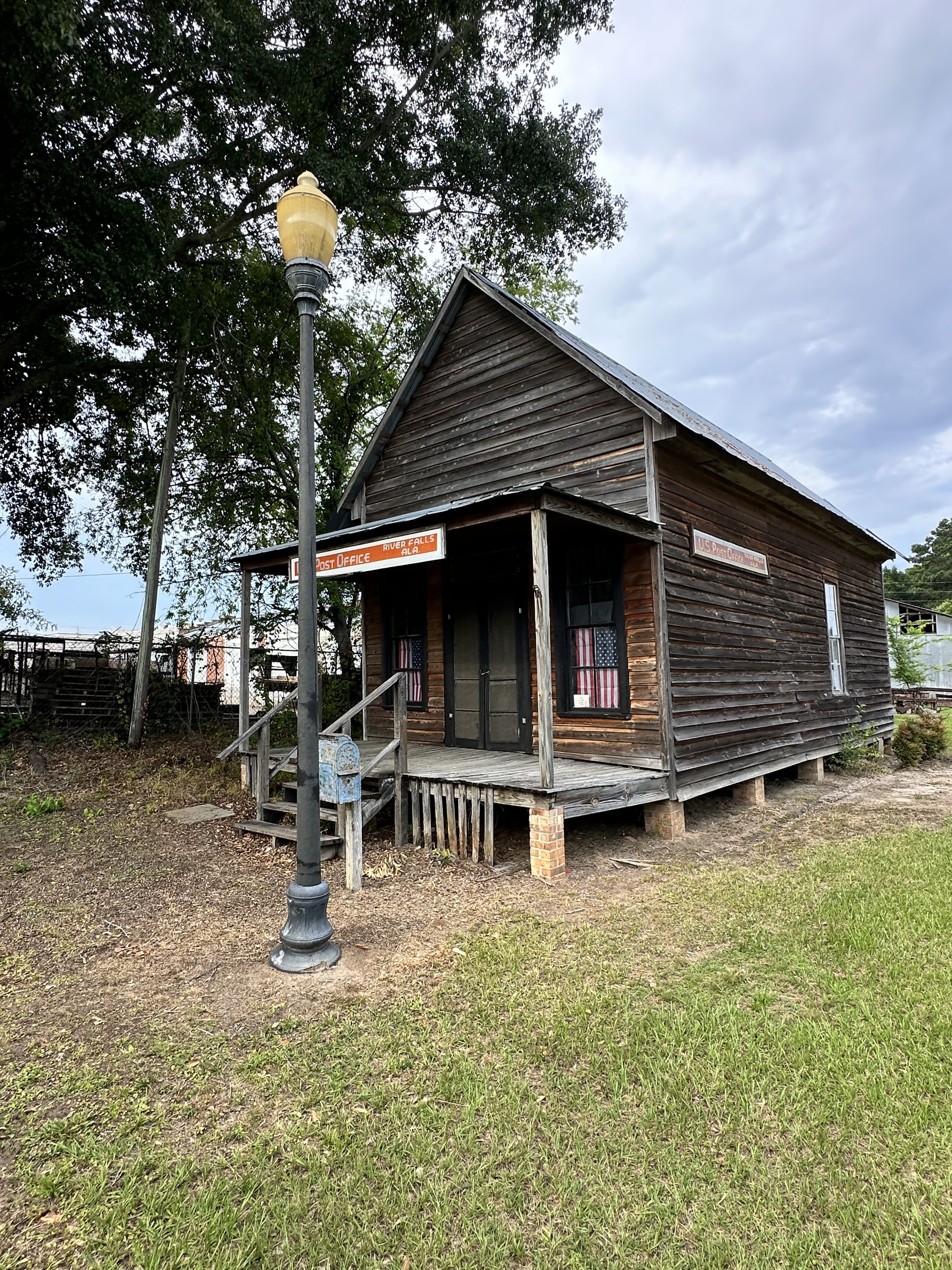
Montezuma grew quickly by frontier standards. By the mid-1830s it had stores, a post office, a courthouse (Covington County was organized in 1821), several mills, and a scattering of houses. The river provided transportation downstream toward Pensacola and the Gulf, essential for a community with no good roads connecting it to the rest of Alabama. Pine timber, naval stores, and agricultural products floated down the Conecuh on flatboats and rafts.
But Montezuma had a fatal flaw: it sat in a floodplain. The Conecuh is a small river by Alabama standards, but even small rivers can rage when the Gulf sends up heavy rain. And in February 1841, a catastrophic flood — remembered locally as the “Harrison Freshet” because it coincided with the inauguration (and rapid death) of President William Henry Harrison — drowned the town.
The Conecuh rose fast, submerging the falls, tearing buildings from their foundations, and washing away most of the settlement. When the water receded, Montezuma was finished. A few residents rebuilt, but the commercial and governmental center of Covington County couldn’t risk another flood. The decision was made to move.
Andalusia: The Spanish-Themed Town on Higher Ground
The new county seat was established about four miles east-northeast of the ruined Montezuma site, on higher ground safely away from the river. The town was laid out in 1844 with a public square at the center — the standard pattern for Southern county seats — and lots sold to merchants, lawyers, and craftsmen eager to set up in the new location.
They called it Andalusia.
The name was part of a broader naming theme in the area that reflected the romantic fascination with Spain common among educated Southerners of the antebellum period. Nearby Geneva County took its name from the Swiss city. Florala, on the Florida-Alabama line, combined both state names. And Andalusia evoked the legendary region of southern Spain — a gesture of cultural aspiration in a town that was, in practical terms, a raw frontier settlement with muddy streets and log buildings.
The name was pure romanticism. There was no Spanish heritage here — Spain had claimed the region until 1819, but Spanish settlement never extended this far north from Pensacola. There was no architectural connection — early Andalusia was built of pine, not adobe. And there was certainly no cultural connection to Moorish Spain. It was just a pretty name, chosen by people who wanted their town to sound like something more than “New Montezuma” or “Covington Courthouse.”
But the name stuck. And in the century and a half since, Andalusia has become definitively itself — a South Alabama town with its own identity, Spanish name notwithstanding.
Building a Town in the Piney Woods
Early Andalusia was small, rough, and isolated. The 1850 census recorded a Covington County population of just 2,945 people, spread across hundreds of square miles of pine forest. Most were subsistence farmers, growing corn and sweet potatoes, raising hogs that ranged free in the woods, and producing just enough cotton or timber to trade for necessities they couldn’t make themselves.
The town itself probably had fewer than 200 residents in the 1840s and 1850s. There was a courthouse, of course — the whole point of the town’s existence. A jail. A handful of stores selling dry goods, hardware, and whiskey. A blacksmith. A few lawyers. A doctor or two. Churches, initially meeting in homes or shared buildings until they could afford to build. And a rotating cast of ambitious young men hoping to make something of themselves in a place where a sharp mind or a strong back could matter more than family pedigree.
Everything was built of longleaf pine — the most abundant and most useful resource in the region. Longleaf lumber was strong, rot-resistant, and available in staggering quantities. Old-growth longleaf could produce boards two feet wide and forty feet long, cut from trees that had been growing since before Columbus. Early Andalusia was literally carved out of an ancient forest.
The economy ran on subsistence, barter, and a trickle of cash from the outside world. Farmers traded labor and goods with each other. Merchants extended credit, knowing they’d be paid at harvest or when the hogs were sold. The few people with actual money — usually because they’d brought it from wherever they came from — could buy land, slaves, and influence.
Transportation: Rivers, Roads, and Isolation
Until the railroads arrived in 1899, Andalusia was profoundly isolated. The Conecuh River, which had powered Montezuma’s mills, was navigable downstream but less useful for upstream travel. Most goods and people moved overland, on roads that were little more than cleared traces through the forest — muddy in winter, dusty in summer, always slow.
Travel to Montgomery, the state capital, took days. Travel to Pensacola, the nearest port city, was only slightly faster. Communication with the outside world depended on mail stages and the rare newspaper that made it this far south. National news arrived weeks late. If you wanted to know what was happening in the world, you relied on travelers, peddlers, and the slow circulation of printed material through country stores and courthouse gatherings.
This isolation had political consequences. Covington County and its neighbors in the Wiregrass developed a regional identity distinct from the Black Belt plantation counties to the north or the Gulf Coast to the south. This was piney woods country: poor, white, isolated, and proud of its independence. That identity would matter enormously when Alabama faced the secession crisis in 1861.
County Seat Wars and Early Growth
Establishing Andalusia as the county seat didn’t end debate about where the courthouse should be. As new settlements developed in other parts of Covington County through the 1840s and 1850s, some residents pushed to move the county seat again — either to a more central location or to their own town.
These “county seat wars” were serious business. Being the county seat meant guaranteed foot traffic, money flowing through the local economy, and political influence. Towns lived or died on the question. In Andalusia’s case, the decision stuck, but not without periodic grumbling from outlying areas that felt neglected or exploited by the town’s political dominance.
By 1860, on the eve of the Civil War, Andalusia was still small but had established itself as the clear commercial and governmental center of Covington County. The courthouse square was the site of court sessions, elections, public auctions, political speeches, and social gatherings. The stores around the square stocked a widening array of manufactured goods — tools, cloth, firearms, luxury items — brought in by wagon from Mobile or Montgomery. The town even had a newspaper, the Covington Times, which began publication in the 1850s.
But Andalusia was still fundamentally a frontier town. Unpaved streets. No running water. No gas lights. Wood-frame buildings that burned regularly. Seasonal disease — malaria, dysentery, yellow fever — that kept the population turnover high. And an economy entirely dependent on agriculture and forest products extracted with hand tools and animal labor.
That was about to change — not because of local innovation, but because the entire South was about to be torn apart by war.
Incorporation and Legal Identity
Andalusia was formally incorporated in 1884, forty years after its founding. The delay was typical for Southern towns of this era — incorporation required a certain population threshold and the political will to establish municipal government, with its attendant taxes and regulations.
The 1884 incorporation gave Andalusia legal existence as a town with defined boundaries, elected officials, and municipal authority over streets, sanitation, law enforcement, and business regulation. It marked the town’s transition from an informal settlement centered on the courthouse to a legally recognized municipality with its own governance distinct from the county.
By that point, Andalusia had survived the Civil War, endured Reconstruction, weathered two courthouse fires (in 1878 and 1895), and was positioning itself for the economic transformation that would arrive with the railroads in 1899. The town’s population was still small — probably under 1,000 — but it was growing, stable, and increasingly connected to the regional and national economy.
The courthouse square remained the center of life. Court days brought crowds from across the county. Political campaigns culminated in speeches on the courthouse steps. Public auctions sold everything from land to livestock to confiscated property. And on slower days, men gathered in the shade of the square’s trees to trade news, swap stories, and debate the questions of the day.
It was, in its essentials, a Southern county-seat town: conservative, agricultural, isolated, and deeply rooted in the patterns of rural Southern life that would persist, with only gradual change, until the mid-20th century. The Spanish name suggested romance and aspiration. The reality was pine trees, red clay, hard work, and a community figuring out how to build a future in a place that, just a generation before, had belonged to someone else entirely.