Beyond the City Limits: Covington County
Andalusia is the county seat, but it's only part of the story. Covington County spreads across 1,034 square miles of piney woods, river bottoms, and wiregrass country, home to 37,748 people...
Audio narration coming soon
A narrated version of Beyond the City Limits: Covington County is being prepared.
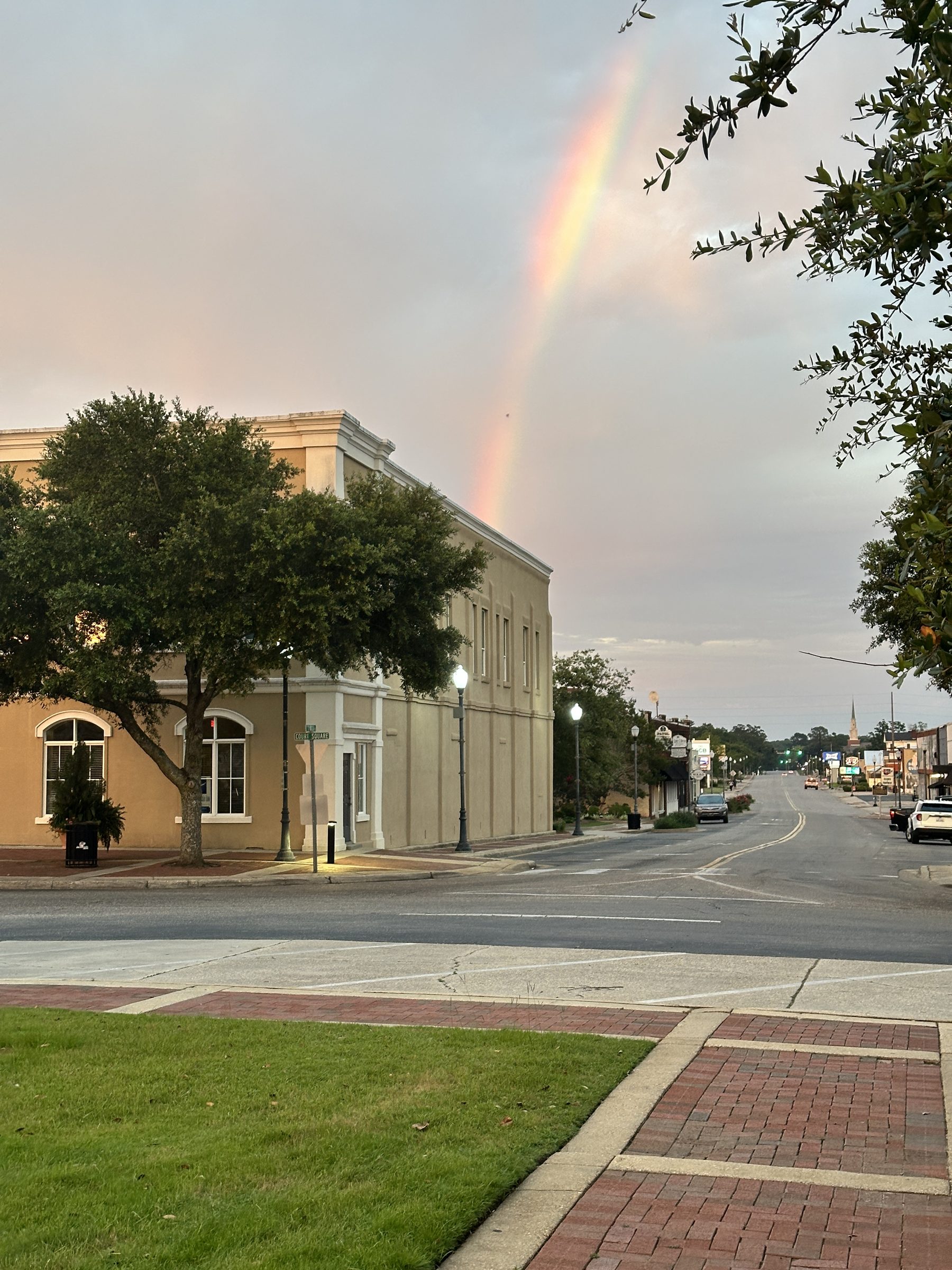
Andalusia is the county seat and only part of the story. Covington County spreads across 1,034 square miles of piney woods, river bottoms, and wiregrass country, home to 37,748 people scattered across incorporated towns, unincorporated communities, and rural homesteads. Understanding Andalusia means understanding the county it serves. The courthouse on the square is a city landmark and the place where the entire county comes to handle legal business, record deeds, get married, and vote.
This is the rest of Covington County.
Geography: Rivers and Pine Forests
Covington County is defined by water and trees. The Conecuh River flows south through the western part of the county, its waters eventually reaching the Gulf of Mexico via the Escambia River in Florida. The Pea River marks the eastern edge, and the Yellow River drains the southern portion. These river systems shape where people settled, where floods happen, and where the best farmland lies.
The rest is pine forest, or at least it used to be. Before 1900, this was longleaf pine wilderness, 1,034 square miles of open, fire-maintained forest with a wiregrass understory. The timber companies cut it all down between 1900 and 1930. What grew back was loblolly and slash pine plantations, managed forests harvested on 25-year rotations. The Conecuh National Forest (84,000 acres in the southwestern part of the county) represents the federal government’s attempt to restore what was lost. The Forest Service manages it with prescribed fire, trying to bring back the longleaf pine ecosystem that defined this landscape for millennia.
The county sits 85 miles from the Gulf of Mexico, close enough to feel hurricanes but far enough inland to mostly dodge the worst of them. It’s flat to gently rolling, with sandy soils that drain quickly: good for peanuts and pine trees, mediocre for cotton, which is why this was never plantation country like the Black Belt to the north.
The Incorporated Towns
Opp: The Crossroads City
Population: 6,576 (2020)
Opp sits at the intersection of US-331 (Montgomery to the Gulf Coast) and US-84 (the east-west route across south Alabama), and that crossroads location has defined the city since the railroad came through in the late 1890s. Named for Henry Opp, an attorney who helped secure right-of-way for the railroad, the city was incorporated around 1901 during the timber boom.
With nearly 6,600 residents, Opp is the second-largest city in the county and serves as the commercial center for the eastern half of Covington County. It has its own school system (Opp City Schools, home of the Bobcats), its own hospital (Mizell Memorial, which has faced challenges over the years), and enough retail to function as a self-contained small city.
What Opp is famous for, though, is snakes.
The Opp Rattlesnake Rodeo, held annually on the first Saturday in March since 1960, is one of the most recognized events in Alabama. At its peak, it drew 25,000-40,000 people for a weekend of rattlesnake handling demonstrations, snake races, venom milking, fried rattlesnake meat, carnival rides, and a beauty pageant. Eastern diamondback rattlesnakes (Crotalus adamanteus) are abundant in the piney woods, and the rodeo grew out of that practical reality.
The event has faced criticism from animal welfare organizations and herpetologists who argue that rattlesnake roundups are cruel, deplete wild populations, and promote misunderstanding of an ecologically important predator. The controversial practice of pouring gasoline into gopher tortoise burrows to flush out snakes (destructive to the threatened tortoise population and environmentally damaging) has been associated with some roundups, though the extent of the practice at Opp is unclear. The rodeo has evolved over the decades, incorporating more educational messaging while maintaining the live snake demonstrations that remain its core attraction.
Like it or not, the Rattlesnake Rodeo is part of Opp’s identity. It generates significant tourism revenue and puts the city on the map. It also opens a window into the complicated relationship between rural Southern culture and environmental conservation, a tension that plays out across the region.
Beyond the rodeo, Opp faces the same challenges as Andalusia: manufacturing decline (the old Opp Cotton Mill and textile plants are long gone), population stagnation, brain drain, and the struggle to create economic opportunity in a global economy that doesn’t favor small rural cities. Opp survives, the retail stays open, the schools function, and US-331 keeps bringing beach traffic through town all summer long.
Florala: The State Line Town
Population: 1,952 (2020)
Florala sits directly on the Alabama-Florida border, and its name says it all: a portmanteau of Florida and Alabama. The city straddles the 31st parallel, with part of the community in Covington County, Alabama and part in Walton County, Florida (though the larger portion is on the Alabama side).
What makes Florala special is Lake Jackson, a 450-acre natural sinkhole lake that literally crosses the state line. You can swim in Alabama water, paddle 100 yards, and be in Florida. The lake is spring-fed, relatively rare for Alabama (most “lakes” here are man-made reservoirs), and serves as the recreational center of the community. Florala State Park, established on the Alabama shore, provides swimming, fishing (bass, bream, catfish), camping, and picnicking. The lake draws visitors from both states and gives the tiny town an identity as a lake community.
Florala incorporated around 1901 during the timber boom, boomed while the sawmills ran, and settled into quiet decline when the forests were cut over. Today it’s a town of under 2,000 people, far from any interstate, serving primarily as a residential community for people who work in the area or who value the lake lifestyle. The proximity to Florida (Crestview, DeFuniak Springs, and eventually the Gulf beaches) means some residents commute south for work or shopping. The state line is more of a curiosity than a barrier; families and churches and friendships cross back and forth without thinking much about it.
Florala City Schools (the Wildcats) serve the local kids, and Friday night football remains a community gathering point even in a town this small. The challenges are what you’d expect: limited economic base, aging population, young people leaving, and the question of what a town this size can offer in a world that increasingly values scale and connectivity.
Red Level: The Red Clay Town
Population: 459 (2020)
Red Level is a tiny incorporated town in central-eastern Covington County, named for the distinctive red clay soil found at a particular elevation in the area. That red soil, iron-rich and heavy, was a landmark for early settlers navigating the piney woods.
Like every small Covington County town, Red Level grew during the timber boom when the railroad came through, peaked in the early 20th century, and has been declining slowly ever since. At its height, the town had a bank, cotton gin, general stores, and a school. Today it has a post office, a few churches, and a handful of businesses. The population of 459 makes it one of the smallest incorporated municipalities in the county.
Red Level School, part of the Covington County School System, serves as the community anchor. In rural Alabama, schools are more than educational institutions. They’re identity markers, gathering places, and sources of community pride. When schools close or consolidate, communities often lose their sense of cohesion. Red Level’s school survival is part of what keeps the town alive as more than a name on a map.
For everything else (groceries, healthcare, significant shopping), Red Level residents drive to Andalusia or Opp. The pattern repeats across rural America: the small town as bedroom community, the county seat as service center, and the recognition that below a certain population threshold, you can’t sustain much retail or professional services.
Lockhart: The Southern Settlement
Population: ~500 (2020)
Lockhart, named for a prominent local family, is a small incorporated town in southern Covington County near the Florida line. It developed as a farming and timber community in the late 19th century, boomed during the sawmill era, and transitioned to agriculture when the timber was gone.
Today Lockhart’s approximately 500 residents live in a quiet town close to the Conecuh National Forest. The forest’s proximity means some residents work in forestry or forest-related recreation, and the town serves as a residential base for people who value rural living and don’t mind the distance from larger services. Like Florala, Lockhart’s position near the Florida state line creates some cross-border connections (shopping, work, medical care) with Crestview or DeFuniak Springs.
Students attend Covington County Schools, the town has churches and a volunteer fire department, and daily life revolves around the rhythms of a small Southern town: church on Sunday, high school sports, hunting season, and the agricultural calendar.
River Falls: The Dam Town
Population: 524 (2020)
River Falls sits on the Conecuh River in western Covington County, named for rapids or shoals that made the river crossing notable to early settlers. The town’s location near those river falls meant water power potential, and mills operated in the area for decades.
What changed River Falls was hydroelectric power. Point A Dam, constructed by Alabama Power Company on the Conecuh River, created Point A Lake (820 acres) and brought electricity, flood control, and recreation to the area. The dam was part of E.L. More’s broader vision for hydroelectric development in south Alabama. More’s Horse Shoe Lumber Company had dominated the timber industry in western Covington County before a devastating 1929 flood destroyed his facilities at River Falls.
Today River Falls is a small town with a lake-recreation dimension. Point A Lake attracts anglers (largemouth bass, crappie, bream, catfish) and boaters, and lakeside residences give the community more vitality than it might otherwise have. The town still has just over 500 people, though the lake makes it feel less isolated.
Carolina, Gantt, and the Smallest Towns
Covington County has several other incorporated municipalities with populations ranging from 200 to a few hundred: Carolina in the north (named, likely, for settlers from the Carolinas), Gantt near Gantt Dam and Gantt Lake, and a handful of others that maintain formal incorporation even as their populations dwindle. These towns persist mostly as legal entities and identity markers, with a mayor, a minimal town council, and a fire department if they’re lucky. Daily life for residents is oriented toward the county seat or larger towns for services.
The Unincorporated Communities
Beyond the incorporated towns are dozens of unincorporated communities: crossroads settlements, church-centered communities, and named places that persist on maps and in local memory even as their populations have scattered.
Wing and the Conecuh National Forest
Wing is a tiny unincorporated community in southern Covington County near the Conecuh National Forest. It’s notable primarily because it’s the closest settlement to Open Pond Recreation Area, one of the forest’s key attractions.
Open Pond is a natural, spring-fed 25-acre lake (one of the few genuine natural lakes in Alabama) managed by the U.S. Forest Service. The recreation area offers swimming, camping (tent and RV sites), fishing, and hiking access to the 20-mile Conecuh Trail that loops through restored longleaf pine ecosystem. Open Pond and the surrounding forest are significant for their ecological restoration work: prescribed burning maintains the fire-dependent longleaf pine ecosystem, and the forest supports endangered red-cockaded woodpeckers, threatened gopher tortoises, and eastern indigo snakes.
Wing itself is a scattering of houses and a church, not a town in any meaningful sense. The name persists because of the forest connection, and for hunters, hikers, and naturalists, Wing is the landmark that tells you you’re close to Open Pond.
Horn Hill, Babbie, Heath, and Pleasant Home
These unincorporated communities represent the pattern that repeats across rural Alabama: a name on a map, a church or two, a cemetery, scattered houses, and the memory of what used to be. Many had schools before consolidation. Some had post offices before rural free delivery made them obsolete. A few had general stores or filling stations.
Horn Hill, located along US-331 between Andalusia and the Crenshaw County line, has slightly more visibility than most because the highway brings traffic through. Pleasant Home in the northeast retains identity through Pleasant Home School (Covington County Schools), which serves students from the surrounding rural area and anchors the community. Heath, near Andalusia, has historical significance as the reported site where Andrew Jackson’s troops camped at Soldier’s Head Creek while traveling the Three Notch Trail during the Creek War era.
Babbie, in western Covington County, is as small as a named community gets: under 100 people, a church, farmland, and forest. The name might come from a family, a nickname, or possibly a literary reference. The name endures because people who live there identify with it.
Onycha, Libertyville, and the Biblical Names
Drive through rural Alabama and you’ll see them everywhere: Antioch, Mount Carmel, Bethel, Onycha. These biblical names reflect the deep religious culture of 19th-century Southern settlement. Onycha, a small community in eastern Covington County, takes its name from a biblical ingredient in the sacred incense described in Exodus. Whether the settlers who chose the name read that far into the Old Testament or simply liked the sound of it, we’ll never know. The community centered on a church (likely Baptist), and the church gave the community its identity.
Most of these biblically named communities are now little more than a church building, a cemetery, and a few houses. The schools have been consolidated, the post offices closed, the stores long gone. People still identify as being “from Onycha” or “from Antioch” even if they live miles away now. The community is a lineage now more than a place, a set of family connections and shared memories.
The Ghost Towns
Montezuma: The Lost County Seat
The most historically significant ghost town in Covington County is Montezuma, the original county seat. Established in the 1820s on the banks of the Conecuh River near the falls, Montezuma served as the governmental center of the newly created county. It had the courthouse, the post office (first postmaster: John Devereaux, appointed 1826, known as the “Father of Covington County”), and the handful of stores and taverns that constituted a frontier county seat.
The site was poorly chosen. In 1841, a catastrophic flood (known locally as the Harrison Freshet) devastated the riverside settlement. The flood brought standing water, which bred mosquitoes, which brought “mosquito fever” (likely malaria or yellow fever). A courthouse fire in 1839 had already begun the push for relocation. Between 1839 and 1844, the county seat moved four miles east to higher ground on the watershed divide between the Conecuh and Yellow Rivers. That new site became Andalusia (post office established July 18, 1844).
Without the courthouse, Montezuma died. The population drifted away, the buildings collapsed or were dismantled for materials, and the forest reclaimed the site. Today there’s nothing left: no structures, no markers, just a location on old maps and in historical records. Archaeologically, the site would be fascinating, but it remains unexcavated as far as public records show.
The story of Montezuma is a reminder that settlement patterns aren’t permanent. Places rise and fall based on transportation routes, natural disasters, economic shifts, and decisions made by people whose names we’ve mostly forgotten.
Rose Hill, Sanford, and the Sawmill Towns
Rose Hill, established in 1823, was one of the earliest settlements in Covington County, even older than Montezuma in some accounts. Located in the western part of the county, it was a farming community that never grew large enough to sustain itself once the county’s economic center shifted eastward to Andalusia. Today it’s a name, a cemetery, and scattered descendants who remember.
Sanford was a timber town that existed to serve a sawmill. When the mill closed and the timber was exhausted, there was no reason for Sanford to exist. The workers moved on, the buildings were abandoned, and the settlement disappeared. Dozens of similar sawmill towns vanished from Covington County between 1920 and 1940: temporary communities built around a single industrial operation that left almost no trace once the operation shut down.
The timber boom created these instant communities and destroyed them just as quickly. Some transitioned to agriculture and survived. Others didn’t have the land base or the railroad connection to survive, and they simply ceased to exist. Their names appear on early 20th-century maps and in census records, then disappear.
The County Identity: Rural, Agricultural, Conservative
What holds Covington County together as a place?
Geography: The river systems, the pine forests, the sandy soils. The physical landscape creates a shared experience. Farming peanuts in Red Level and raising cattle near Florala aren’t identical lives, but they’re closer to each other than either is to life in Montgomery or Mobile.
Agriculture and Forestry: Even though only about 5-6% of county employment is directly in agriculture or forestry, those industries shape the culture. The agricultural calendar (planting season, harvest, hunting season) structures life. Pickup trucks aren’t an affectation; they’re functional. Everybody knows somebody who farms, logs, or owns timber land.
Hunting Culture: Deer season, turkey season, hog hunting. The county’s extensive forests and private land mean hunting is woven into the social fabric. Opening day of deer season is practically a holiday. People hunt for meat for the freezer as much as recreation, and it connects them to the land in ways that suburban life doesn’t.
School Sports: Football especially. Every town has a team, every Friday night in fall draws the community together, and high school athletics provide identity and cohesion. The rivalry between Andalusia and Opp is real, and so is the shared pride when a Covington County kid makes it to college ball or beyond.
Church: Baptist, Methodist, Pentecostal, Church of Christ. The churches are everywhere. Sunday morning is still church time, Wednesday night is Bible study, and church membership structures social networks and defines community standing. Less universal than it was 50 years ago, the church remains central to rural Southern life in a way that surprises people from more secular regions.
Conservative Politics: Covington County votes Republican by wide margins in presidential and state elections, though local politics are more personal. People vote for who they know, who their families know, and who they trust to fix the roads and keep taxes low. National culture war issues get attention, but local politics are about sewers, school funding, and economic development.
The Relationship with Andalusia: Every small town and rural community in Covington County is oriented toward Andalusia for certain functions. The courthouse is where you record deeds, file lawsuits, get married, and handle probate. If you need a lawyer, Andalusia is where you find one. Serious medical care starts at Andalusia Health. The Three Notch Museum holds the county’s collective history. Andalusia is the hub, and everything else radiates outward.
That hub-and-spoke relationship creates tension. Andalusia gets the sales tax revenue from retail. Andalusia gets the state and federal attention. Andalusia gets the downtown revitalization money. Meanwhile, the rural areas and small towns feel neglected: their roads are worse, their internet is slower, their schools have fewer resources, and nobody in Montgomery cares. The familiar rural grievance: the perception that resources flow toward the center while the periphery struggles.
The Florida Connection
The southern border with Florida shapes Covington County in ways that aren’t always obvious.
Lake Jackson at Florala literally straddles the state line, creating a binational (or bi-state, at least) community where Alabama and Florida residents share the same lake, shop in each other’s towns, and intermarry without thinking twice about the border.
Gulf Coast Tourism: The Florida panhandle beaches (Destin, Fort Walton Beach, the 30A corridor) are 60-90 miles south of Andalusia. US-331 is a primary route connecting central Alabama to the Gulf Coast, which means beach traffic flows through Opp and Florala all summer long. That transit traffic supports gas stations, convenience stores, and fast food restaurants in both towns.
Economic Ties: Some Covington County residents, particularly in the southern communities like Florala and Lockhart, commute to jobs in Okaloosa or Walton County, Florida. The military installations at Eglin Air Force Base and Hurlburt Field in the Florida panhandle provide employment for some county residents. Conversely, some Florida residents cross the line for Alabama’s lower taxes and cheaper land.
Cultural Overlap: The Alabama-Florida border region shares more culture than it separates. The piney woods, the Southern Baptist dominance, the hunting and fishing culture, the small-town conservatism: continuous on both sides. People on both sides of the line watch the same Pensacola TV stations, listen to the same country radio, and root for the Crimson Tide or the Seminoles (or both).
The County Government
Covington County is governed by a four-member county commission plus a commission chairman, elected from districts. The commission handles county roads (hundreds of miles of rural roads that nobody else will maintain), the county budget, county buildings, and general administration. The Covington County Courthouse in Andalusia, a 1916 Frank Lockwood design, is where the commission meets and where most county business happens.
The Probate Judge is one of the most important officials in Alabama county government. In Covington County, the Probate Judge handles estates, wills, guardianships, adoptions, mental health commitments, marriage licenses, and election administration. The office has been central to county governance since 1821.
The Sheriff’s Office provides law enforcement for the unincorporated areas (about 25,000 of the county’s 37,748 residents live outside city limits) and operates the county jail. Covering 1,034 square miles with a limited budget and staff is a perpetual challenge. The relationship between the sheriff’s deputies and municipal police departments (Andalusia, Opp, Florala) requires coordination and mutual support.
What the County Faces
Covington County’s challenges mirror rural America’s challenges:
Population Decline: The county population peaked at 42,417 in 1940, when textile mills and agriculture provided widespread employment. It’s 37,748 now and declining slowly. Young people leave. Old people stay. The median age is rising.
Brain Drain: Smart kids go to college and don’t come back. There aren’t enough good jobs to keep them. The county exports its educated youth and imports poverty through lack of opportunity.
Economic Transition: Timber is gone (as extractive industry), textiles are gone, agriculture is mechanized and requires fewer workers. What replaces them? Manufacturing requires global competitiveness. Tourism is limited by the county’s distance from major destinations. Remote work could help if the internet improves, but that’s a big “if.”
Infrastructure: Rural roads, aging water and sewer systems, inadequate broadband, underfunded schools. The infrastructure deficit is real and growing. Counties don’t have the tax base to fix it, the state doesn’t prioritize rural areas, and federal aid is unpredictable.
The Opioid Crisis: Rural Alabama has been hit hard by opioid addiction, with prescription pills transitioning to heroin and fentanyl. The crisis strains law enforcement, healthcare, social services, and families. It’s rarely talked about in official documents or public meetings, though it’s there.
Racial Inequality: African American residents of Covington County face the same structural disadvantages they face across the rural South: lower incomes, higher poverty rates, less wealth accumulation, and limited pathways to economic mobility. The county is majority white, but the legacy of slavery, Jim Crow, and systematic exclusion from economic opportunity shapes current reality.
Why It Matters
Covington County beyond Andalusia matters because this is where most Americans used to live and where many still do. The small towns, the unincorporated communities, the rural homesteads aren’t picturesque relics or tourist attractions. They’re home to 37,748 people trying to make a living, raise families, and maintain communities in an economy that has largely written them off.
Understanding Andalusia requires understanding that the city doesn’t exist in isolation. The town is the county seat, the service center, the hub of a rural network that extends across 1,034 square miles. When the courthouse on the square processes a deed, it might be for land in Wing or Babbie. When Andalusia Health treats a patient, they might have driven from Florala or Red Level. When the Covington County School System decides where to consolidate schools, it’s making decisions that will define community survival for tiny towns that can’t afford to lose their schools.
People still farm, log, teach school, run small businesses, coach Little League, and organize church suppers across every corner of the county. The Rattlesnake Rodeo still draws crowds. The lakes still attract anglers. The Conecuh National Forest still offers some of the most ecologically significant land in the Southeast.
Like rural communities across America, Covington County is adapting. Some smaller communities have consolidated, while Andalusia as county seat continues to anchor the region’s economy, government, and services. New developments like the Coneca Sausage plant bring fresh employment, and the county’s natural assets (forests, rivers, lakes) are drawing interest from eco-tourism and outdoor recreation.
Covington County’s story is still being written. The people here are doing the writing.
Population data: U.S. Census Bureau, 2020 Census
Community histories: Covington County Communities research file; Three Notch Museum archives; local government records
Geographic and environmental context: Conecuh National Forest management documents; U.S. Geological Survey; Encyclopedia of Alabama