Notable People of Andalusia
The story of any place is told through its people. For a city of fewer than 9,000, Andalusia has sent a remarkable number of people out into the world who made names for themselves — and kept a few...
Audio narration coming soon
A narrated version of Notable People of Andalusia is being prepared.
The story of any place is told through its people. For a city of fewer than 9,000, Andalusia has sent a remarkable number of people out into the world who made names for themselves — and kept a few remarkable people close to home who shaped the place itself.
These aren’t just names on a list. Each person here represents something about what this city produces: determination, talent that doesn’t wait for permission, and a particular kind of grit that comes from small-town Alabama.
Luther Leonidas Terry, M.D. (1911–1985)
The Surgeon General Who Changed America
If you had to pick one person from Andalusia who changed the most lives, it would be Luther Terry. Born here in 1911, graduated from Andalusia High School, Terry went on to become the U.S. Surgeon General who issued the landmark 1964 report Smoking and Health — the document that fundamentally altered America’s relationship with tobacco.
Before that report, smoking was everywhere: in hospitals, on airplanes, in restaurants, in doctors’ offices. Cigarette companies sponsored television shows and advertised in medical journals. More than 40% of American adults smoked, and the tobacco industry insisted there was no proof that smoking caused cancer or heart disease.
Terry’s report, compiled by a panel of the nation’s leading health experts, concluded definitively that smoking caused lung cancer and chronic bronchitis, and was a probable cause of heart disease. It was released on a Saturday morning — January 11, 1964 — to minimize stock market disruption. The news made front pages across the country.
The backlash was immediate and fierce. Tobacco companies, tobacco-state politicians, and industry-funded scientists attacked the report and Terry personally. But the evidence was overwhelming, and Terry stood firm. The report led directly to warning labels on cigarette packages, the ban on television cigarette advertising, smoke-free laws, and a sustained public health campaign that reduced adult smoking rates from 42% in 1965 to under 14% today.
Millions of lives saved. Cancers prevented. Heart attacks averted. All traceable back to a boy from Andalusia who became Surgeon General.
Terry’s path to that moment started here. After Andalusia High School, he attended Birmingham-Southern College (where he was an athlete), then Tulane University School of Medicine. He served in the Navy during World War II, then built a distinguished career in medicine at Johns Hopkins and Creighton University. President John F. Kennedy appointed him Surgeon General in 1961.
After leaving government in 1965, Terry taught at the University of Pennsylvania Medical School and continued to advocate for public health until his death in 1985. His hometown remembers him: Andalusia named its new Health Center the Luther L. Terry Health Center in his honor.
Terry’s career demonstrates something that echoes through this list: Andalusia doesn’t produce people who wait for the world to come to them. They go out and make it happen.
William March (1893–1954)
The Decorated Marine Who Became Alabama’s Most Important Writer
William March — born William Edward March Campbell in Mobile, raised in various Alabama towns with family connections throughout the region including the Wiregrass — was one of the finest American novelists of the mid-20th century. He was also one of the most decorated U.S. Marines of World War I.
March enlisted in the Marines in 1917 and served with distinction in France. He fought at Château-Thierry, Soissons, Saint-Mihiel, Blanc Mont Ridge, and the Meuse-Argonne Offensive — some of the bloodiest battles in American military history. For his bravery under fire, March received the Navy Cross, the Distinguished Service Cross, and the Croix de Guerre. He was wounded multiple times and left the war with what we now call PTSD, though in his era it was known as shell shock.
Those experiences shaped his first novel, Company K (1933), a devastating account of a Marine company in World War I told through 113 short vignettes from different soldiers. The book is brutal, honest, and unflinching about the cost of war — and it established March as a major literary voice.
March’s other novels include Come in at the Door (1934), The Tallons (1936), and The Looking Glass (1943). But his most famous work came last: The Bad Seed (1954), the chilling story of a sociopathic child murderer. Published just months before March’s sudden death, The Bad Seed became a bestseller and was adapted into a successful Broadway play and a 1956 film. The book introduced the term “bad seed” into the American vernacular and remains a classic of psychological suspense.
March never achieved the same level of fame as his contemporary William Faulkner, but literary critics have long recognized him as one of Alabama’s most important writers — a master of economical prose, psychological insight, and moral complexity.
He died of a heart attack in New Orleans in 1954, at the height of his literary powers. He’s buried in Mobile.
Robert Horry (b. 1970)
“Big Shot Rob” — The Most Clutch Player in NBA History
Robert Horry was born in Andalusia in 1970 and grew up here before his family moved to Andalusia High School’s rival town. But his roots are local, and his career is the stuff of legend.
“Big Shot Rob” won seven NBA championships — more than any player not named Bill Russell, Sam Jones, or a handful of other Celtics from the dynasty era. He won two with the Houston Rockets (1994, 1995), three with the Los Angeles Lakers (2000, 2001, 2002), and two with the San Antonio Spurs (2005, 2007). Seven rings. Three different teams. Sixteen seasons.
Horry wasn’t a superstar. He was never an All-Star. He averaged 7.0 points and 4.8 rebounds per game over his career — solid, but not spectacular. But when the game was on the line, in the biggest moments, Horry delivered.
Game-winners in the playoffs. Clutch three-pointers in elimination games. Defensive stops when it mattered most. His teammates and coaches trusted him completely, and opposing teams feared him. Kobe Bryant called him “the luckiest man alive.” Horry’s response: “Luck is when preparation meets opportunity.”
Some of his most famous shots:
- 1995 NBA Finals, Game 1: Horry hits a three-pointer with seconds left to beat the Orlando Magic, setting the tone for Houston’s sweep and second championship.
- 2002 Western Conference Finals, Game 4: Horry hits a buzzer-beating three to beat the Sacramento Kings in overtime, one of the most controversial playoff series in NBA history. The Lakers went on to win their third straight title.
- 2005 NBA Finals, Game 5: Horry hits a corner three-pointer with 5.9 seconds left to beat the Detroit Pistons, giving the Spurs a 3-2 series lead. They won the championship two games later.
Seven championships. Countless clutch moments. A nickname that sums up his career perfectly.
Horry now works as an NBA analyst. But his legacy is secure: he’s the most clutch player in playoff history, and he’s from Andalusia.
Mayor Earl V. Johnson (b. 1946)
Six Terms and Still Going — The Architect of Modern Andalusia
If you want to understand Andalusia as it exists today, you have to understand Earl Johnson. First elected mayor in 2000, Johnson is now in his sixth term — making him the longest-serving mayor in the city’s history and one of the most transformative leaders this city has ever had.
Johnson didn’t arrive as a career politician. He was a businessman, co-owner of Johnson Cotton Company, deeply rooted in the community. He ran for mayor because he saw potential in Andalusia that wasn’t being realized — and he’s spent the last 25 years realizing it.
Under Johnson’s leadership, Andalusia has:
-
Revitalized downtown: The Square went from struggling to thriving, with new businesses, restored historic buildings, and a renewed sense of civic pride. Johnson pushed for façade grants, infrastructure improvements, and events that bring people downtown.
-
Acquired and opened Springdale Estate: The 1930s estate built by industrialist John Scherf sat empty for years. Johnson led the effort to acquire it for the city, restore it, and open it for public events. It’s now one of Andalusia’s crown jewels.
-
Managed utilities through crisis: Andalusia’s municipal utilities have faced challenges — aging infrastructure, regulatory pressures, rate debates. Johnson has navigated these issues with a steady hand, making unpopular but necessary decisions to keep the lights on and the water running.
-
Pushed for broadband: When Mediacom failed to provide reliable internet service, Johnson publicly called them out and began exploring the possibility of a municipal broadband system — a bold, forward-looking move for a city this size.
-
Led through disasters: Tornadoes, floods, the COVID-19 pandemic — Johnson has been the steady voice during every crisis, coordinating response, communicating clearly, and keeping the community together.
Johnson is not flashy. He’s not a showman. He’s a pragmatist who shows up, does the work, and gets results. He’s in City Hall constantly, accessible to citizens, responsive to problems. At council meetings, he runs a tight ship — respectful but no-nonsense, focused on the business at hand.
Critics will tell you he’s been in office too long, that it’s time for new leadership. Supporters will tell you that six terms is proof that he keeps earning the trust of voters. Either way, when historians write about Andalusia in the early 21st century, Earl Johnson will be a central figure.
Brenda Gantt (b. 1947)
The Grandmother Who Put Andalusia on the Map for Millions
Brenda Gantt didn’t set out to be famous. She was a widow, a grandmother, a longtime Andalusia resident who loved to cook and loved to share. Then, in 2020, her grandson set up a Facebook page and started recording her making biscuits in her kitchen.
It went viral. Millions of views. Then millions of followers.
Today, Brenda Gantt’s Facebook page has over 3 million followers. Her videos — simple, unpolished, filmed on a phone — show her cooking Southern classics: biscuits, cornbread, fried chicken, butter beans, pecan pie, banana pudding. She talks while she cooks, offering advice, telling stories, praying over her viewers.
What makes Brenda special is the authenticity, food and everything around it. There’s no gimmick, no production value, no filter. She’s a grandmother in her kitchen, cooking the way she’s cooked for decades, sharing it with the world. People respond to that across the South and everywhere else. In a manufactured, curated, overly produced digital world, Brenda Gantt is real.
She’s written cookbooks. She’s made national news. She’s been profiled by major media outlets. And she’s put Andalusia, Alabama on the map for millions of people who’d never heard of it before.
Her videos regularly mention Andalusia, the town square, local businesses. She’s proud of her hometown, and she’s given it a level of exposure that no chamber of commerce budget could ever buy.
Brenda Gantt represents a certain kind of Andalusia success: not leaving, not seeking fame, just doing what you do well and letting the world come to you. It came.
Seth Hammett (b. 1958)
Speaker of the Alabama House of Representatives
Seth Hammett served in the Alabama House of Representatives from 1978 to 2010 — 32 years — and was Speaker of the House from 2003 to 2010. That makes him one of the most powerful politicians Alabama has produced in the modern era, and he’s from right here.
Hammett was first elected at age 20, fresh out of the University of Alabama, representing District 88 (Covington County). Over three decades, he became a master of legislative process, coalition-building, and state politics. As Speaker, he wielded enormous influence over state budgets, policy priorities, and the legislative agenda.
His tenure as Speaker coincided with significant challenges: budget crises, education funding battles, Medicaid shortfalls, debates over gambling, and the aftermath of Hurricane Katrina. Hammett was known as a pragmatic, deal-making Democrat in a state that was rapidly shifting Republican — a difficult position that required political skill and careful navigation.
After leaving the legislature in 2010, Hammett became executive director of the Alabama League of Municipalities, representing cities and towns across the state on legislative and policy issues.
For Andalusia, Hammett was a direct line to state power for decades. When the city needed something from Montgomery, they called Seth. His success reflects a tradition of Andalusia producing people who understand how power works and know how to use it.
Frank J. Tipler (b. 1947)
The Andalusia Physicist Who Theorized the Omega Point
Frank Tipler, born in Andalusia in 1947, is a mathematical physicist and cosmologist at Tulane University whose work sits at the intersection of physics, philosophy, and theology. He’s also one of the most controversial scientists to come out of Alabama.
Tipler’s early work was in general relativity and cosmology. He co-authored The Anthropic Cosmological Principle (1986) with British cosmologist John Barrow, a serious academic work that explored the fine-tuning of the universe and the possible significance of intelligent life in cosmic evolution.
Then Tipler went further. In The Physics of Immortality (1994), he proposed the “Omega Point” theory — the idea that the universe will eventually collapse into a final singularity, and that intelligent beings in the far future will have infinite computational power, allowing them to resurrect every person who has ever lived in a simulated reality that is functionally equivalent to eternal life.
It’s a wild idea. Some scientists dismissed it as pseudoscience dressed up in mathematical language. Others found it fascinating, even if speculative. Tipler argued that his theory was consistent with known physics and Christian theology — resurrection, eternal life, God as the Omega Point.
Regardless of whether you buy the Omega Point, Tipler is a serious physicist with a serious academic career. He’s published extensively in peer-reviewed journals on relativity, quantum mechanics, and cosmology. He’s also proof that Andalusia produces people who aren’t afraid to think big, even if it makes people uncomfortable.
Hannah Barron (b. 1996)
The Andalusia Noodler with Millions of Followers
Hannah Barron is a social media phenomenon. Born and raised in Andalusia, she’s become one of the most recognizable outdoor personalities in the country, with millions of followers across Instagram, Facebook, TikTok, and YouTube.
Her specialty is noodling: catching catfish with your bare hands by sticking your arm into underwater holes and letting the fish bite down on it. Dangerous, visceral, and very, very South Alabama.
Barron’s videos show her hunting, fishing, noodling, shooting, and living the outdoor life. She’s beautiful, tough, and completely comfortable in the woods and water. She wears camo and Realtree, talks with a thick Alabama accent, and presents a version of rural Southern culture that resonates with millions.
She’s also a brand. Barron has sponsorship deals with major outdoor companies, sells merchandise, and has built a business around her personality and skills. She’s proof that in the age of social media, you don’t need to leave Andalusia to reach the world.
For some, she represents a celebration of rural Southern traditions. For others, she perpetuates stereotypes. Either way, she’s famous, she’s from here, and she’s unapologetically herself.
Hank Williams (1923–1953)
The Country Music Legend Who Married in Andalusia
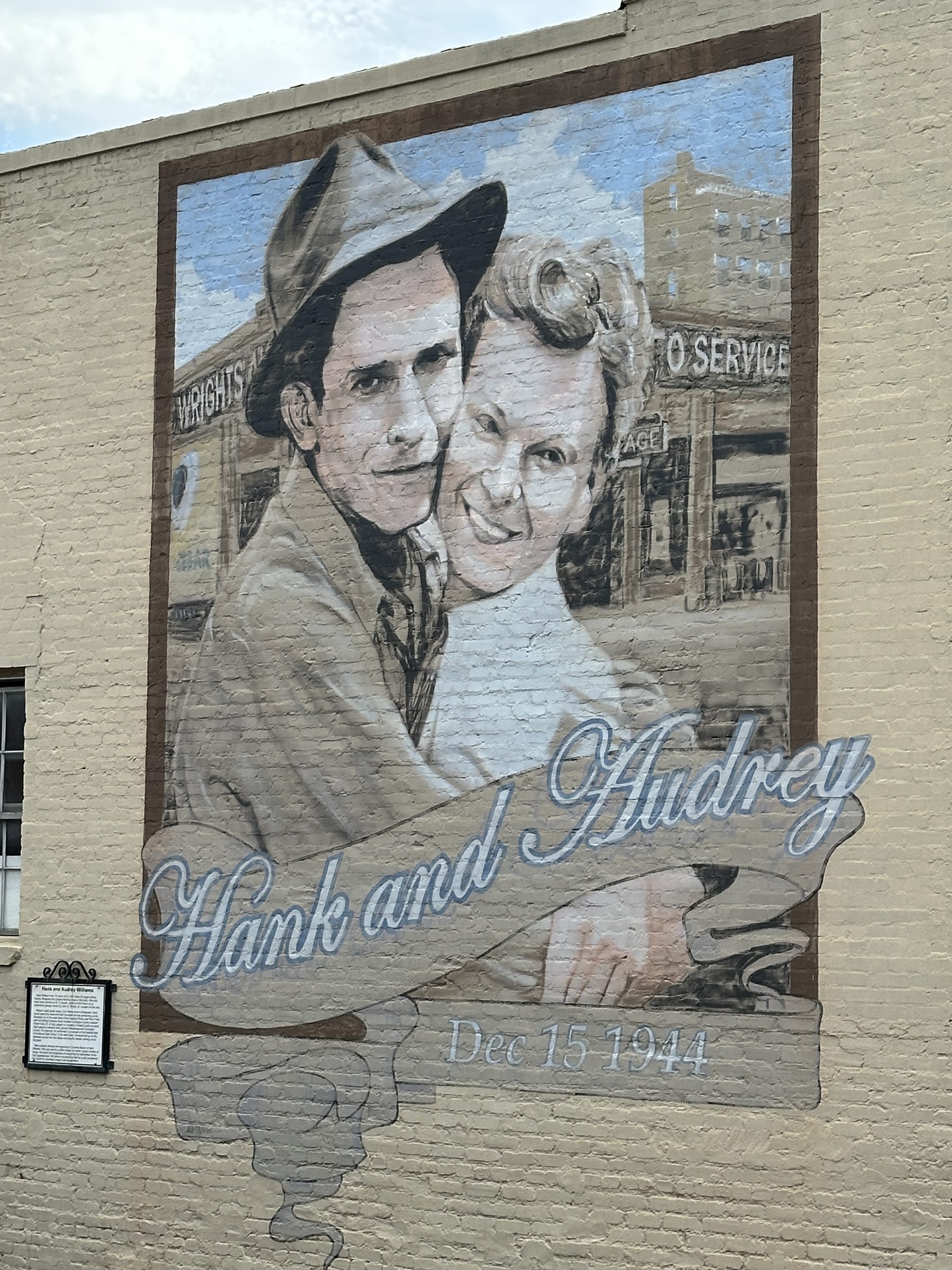
Hank Williams wasn’t from Andalusia. But on December 15, 1944, he married Audrey Mae Sheppard at a Texaco gas station on East Three Notch Street, with a justice of the peace officiating. That makes Andalusia part of the Hank Williams story — and the Hank Williams story is one of the most important in American music.
At the time, Hank was 21, a struggling country singer performing on Montgomery radio and playing honky-tonks throughout Alabama. Audrey, also 21, was from nearby Banks in Pike County — just across the line from Covington County. She was a single mother, determined and ambitious. She saw Hank’s talent and believed in him.
Their marriage was passionate, volatile, and ultimately tragic. They had a son, Hank Williams Jr., who became a country music star in his own right. They divorced in 1952, a year before Hank died in the back seat of a Cadillac on the way to a concert, at age 29.
In his short life, Hank Williams wrote and recorded some of the most enduring songs in American music: “Your Cheatin’ Heart,” “I’m So Lonesome I Could Cry,” “Hey, Good Lookin’,” “Jambalaya,” “I Saw the Light.” His influence on country, rock, blues, and popular music is immeasurable. Bob Dylan, Johnny Cash, Bruce Springsteen — all of them cite Hank as a foundational influence.
The gas station where Hank and Audrey married is part of Andalusia’s history. The Three Notch Museum has documented the connection. It’s a small thread in a larger story, but it’s authentic, and it matters.
John G. Scherf (1862–1941)
The German Immigrant Who Built Andalusia’s Industrial Economy
John George Scherf was born in Germany in 1862, immigrated to the United States as a young man, and eventually settled in Andalusia, where he became the most important industrialist in the city’s history.
Scherf saw opportunity in the South’s textile boom. In the early 20th century, textile manufacturing was moving from New England to the South, where labor was cheaper, unions were weaker, and local governments were eager for economic development. Scherf built the Ala-Tex Manufacturing Company in Andalusia, a shirt factory that at its peak produced more than a million dress shirts per year and employed hundreds of workers.
The factory was the economic backbone of Andalusia for decades. It provided steady jobs, drew workers from across the region, and generated tax revenue that funded schools, roads, and public services. Scherf served as Andalusia’s mayor for four terms and was a major civic benefactor.
He also built Springdale Estate, the grand 1930s property on several acres in town that now serves as a public event space. The estate reflected Scherf’s success and his commitment to Andalusia.
Scherf died in 1941, but his legacy shaped the city for generations. The textile industry eventually declined — Ala-Tex closed in the 1990s — but Scherf’s role in building modern Andalusia is undeniable. Immigrants built this country, and John Scherf is proof.
James U. Cross (b. 1925)
Medal of Honor Recipient
James U. Cross was born in Andalusia in 1925 and served as a U.S. Air Force pilot during the Vietnam War. On February 18, 1969, Major Cross was flying an A-1E Skyraider on a rescue mission in Laos, attempting to locate and protect a downed American pilot.
Cross’s aircraft was hit by anti-aircraft fire and severely damaged, but he continued flying, providing cover for the rescue helicopter until the downed pilot was safely recovered. Cross then managed to fly his crippled plane back to base despite extensive damage and injury.
For his extraordinary heroism, Cross was awarded the Medal of Honor, the nation’s highest military decoration. He later rose to the rank of Brigadier General and served as a pilot for Air Force One.
Cross represents a tradition of military service that runs deep in Andalusia and throughout the South. His courage under fire reflects the best of that tradition.
Willie Tyler (b. 1940)
Ventriloquist and Comedian
Willie Tyler, born in Andalusia in 1940, is a ventriloquist and comedian best known for his act with his puppet sidekick, Lester. Tyler performed on television variety shows, comedy specials, and in clubs throughout the 1970s and 1980s. He appeared on The Tonight Show, Rowan & Martin’s Laugh-In, and other major programs.
Tyler broke barriers as an African American performer in a field dominated by white entertainers. He brought wit, timing, and a sharp comedic voice to his act, and he built a successful career on his talent.
He’s a reminder that Andalusia has produced performers across genres and mediums — and that talent doesn’t have a color line, even if the entertainment industry tried to draw one.
Mackey Sasser (b. 1962)
The Mets Catcher Who Got the Yips
Mackey Sasser, born in Covington County, played Major League Baseball as a catcher from 1987 to 1995, primarily with the New York Mets. He was a solid player — a career .277 hitter, good defensively, well-liked by teammates.
But Sasser is best remembered for developing “the yips” — a psychological condition that made it nearly impossible for him to throw the ball back to the pitcher. He would pump-fake multiple times before releasing the ball, sometimes bobbling it or short-arming the throw. It was painful to watch and ended his career prematurely.
The yips are a real phenomenon, affecting athletes in baseball, golf, and other sports. Sasser has spoken openly about his struggles, and his story has brought attention to the mental challenges athletes face.
He’s from here, and his story is a reminder that talent and hard work aren’t always enough — sometimes the mind gets in the way.
Ivorey Cobb (1918–2015)
Civil Rights Leader and Educator
Ivorey Cobb was born in Andalusia in 1918 and became a towering figure in the city’s African American community as an educator, civil rights activist, and community leader.
Cobb taught in Andalusia’s segregated schools for decades, shaping generations of Black students during the Jim Crow era and the civil rights movement. He was also active in voter registration, civil rights organizing, and efforts to desegregate public institutions.
Later in life, Cobb served as a municipal judge in Andalusia, one of the first African Americans to hold that position in the city.
Cobb’s life spanned nearly a century of Andalusia history — from the depths of segregation through the civil rights movement to the election of Barack Obama. His work made Andalusia a better place, and his legacy deserves to be remembered and honored.
Quinton Dial (b. 1990)
Two-Time National Champion, NFL Defensive Lineman
Quinton Dial was born in Andalusia in 1990 and became a standout defensive lineman at the University of Alabama, where he won two national championships (2011, 2012) under head coach Nick Saban.
Dial was drafted by the San Francisco 49ers in the fifth round of the 2013 NFL Draft and played four seasons with the 49ers, then a season with the Green Bay Packers. He was a solid run-stopper and rotational player on NFL defenses.
His college career stands out: two national titles, part of one of the most dominant defensive lines in college football history. Another reminder that this town produces athletes who compete at the highest levels.
The Through Line
What connects Luther Terry, Robert Horry, Brenda Gantt, and Hank Williams? What do they all say about Andalusia?
They say that talent doesn’t wait for permission. They say that small towns produce big people. They say that if you’re good enough, the world will find you — but you better be ready to do the work.
What Andalusia has is people who figure it out, make it happen, and carry where they’re from with them wherever they go.
That’s the through line.